
Ask most safety teams how they know their program is working, and the answer usually points backward. Fewer injuries than last year. Fewer lost workdays. A clean audit. These are useful measures, but each one depends on something happening first, then counting how often it did not happen again.
That is a reactive model, and it is still the default across most industrial operations, warehouses and distribution centers. It works, in the sense that it catches real problems after the fact. What it does not do well is catch the much larger set of events that come before a serious incident and never get investigated at all.
The Iceberg Beneath Every Serious Incident
In the 1930s, safety researcher Herbert William Heinrich studied industrial injury records and proposed a ratio that still shapes safety thinking today: for roughly every serious injury, there were 29 minor injuries and 300 near misses or unsafe conditions that preceded it. Modern researchers note the exact ratio varies by industry and workplace, and Heinrich’s original methodology has been questioned over the decades. The underlying point has held up better than the specific numbers: serious incidents are rarely isolated events. They sit on top of a much larger, mostly invisible layer of close calls.
Forklifts are a clear example of where that layer exists and where it usually goes unrecorded. According to the National Safety Council’s Injury Facts, citing U.S. Bureau of Labor Statistics data, forklifts were linked to 84 work-related deaths in 2024 and 25,110 injury cases serious enough to require days away from work, restricted duty or job transfer across 2023 and 2024 combined. Behind each of those numbers sits an unknown, and almost certainly much larger, number of close calls that never became a recordable event: a pedestrian who stepped back just in time, a forklift that braked hard at a blind corner, a load that nearly tipped. None of that shows up in an injury report, because nothing was injured.
Why Near Misses Disappear
The gap is not that companies do not care about near misses. It is that capturing them depends on someone deciding to report an event that, by definition, did not cause any harm.
That decision runs into a few predictable obstacles. Reporting takes time in an environment where operators are measured on throughput. It can feel like assigning blame, especially when the near miss involves a person and not just a process. And without a system that flags the event automatically, the memory of it fades before the end of the shift.
Safety programs that build a strong near-miss reporting culture treat these events differently: not as a paperwork requirement, but as the cheapest and safest data a company can collect, since everyone involved is available to explain what happened and nobody got hurt. The organizations that get real value out of near misses also tend to look for patterns, not incidents. A single close call at a blind corner might be one unlucky moment. A dozen of them in the same spot over a month point to a location that needs a mirror, a different traffic pattern or a speed limit, not another toolbox talk.
Leading Indicators, Not Just Lagging Ones
Safety professionals often separate lagging indicators, such as injury rates, lost workdays and insurance claims, from leading indicators, such as near misses, equipment alerts and corrective actions taken before anyone is hurt. Lagging indicators measure what already went wrong. Leading indicators are meant to give a warning first.
A program built mostly around lagging indicators can look calm for months while risk quietly builds toward the next serious incident, because nothing has technically gone wrong yet. Leading indicators give a safety team an earlier signal, but only if the underlying events are actually captured somewhere. This is where most manual, paper-based programs fall short: the leading indicator exists out on the floor, it simply disappears before anyone can record it.
What Proactive Safety Actually Requires
Moving from a reactive model to a genuinely proactive one usually comes down to three things manual processes struggle to deliver:
- Events need to be captured automatically, not left to a form nobody has time to fill out.
- Activity needs to be tied to something specific, such as a vehicle, a location, an operator or a shift, rather than aggregated into a single facility-wide number that hides where risk actually sits.
- Data needs to accumulate over time so patterns become visible, instead of resetting with every new investigation.
None of that requires new behavior from the workforce. It requires the environment itself, the equipment people already use every day, to do the capturing.
A Practical Starting Point, Not a Facility Overhaul
The instinct, once a company decides to get serious about proactive safety, is often to reach for a facility-wide system: cameras throughout the building, a location system covering every zone, wearables for every worker. Those systems have real value, but they represent a significant commitment before anyone has proven where the risk actually concentrates.
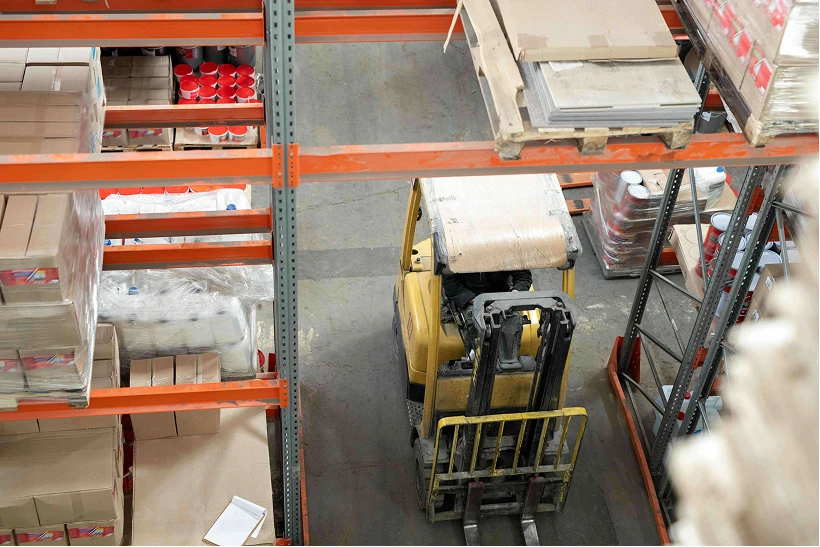
A more practical starting point is the equipment already generating the risk. Forklifts are a good example: they move through nearly every part of a facility, they are involved in a disproportionate share of serious incidents, and modern collision warning systems already sit on the vehicle, detecting the exact moments that matter. Turning that detection into a record, rather than letting the moment disappear once the alert stops sounding, is a far smaller step than instrumenting an entire building. It is also where most of the near-miss data described above is already being generated, just not captured.
Where PathAware® Fits
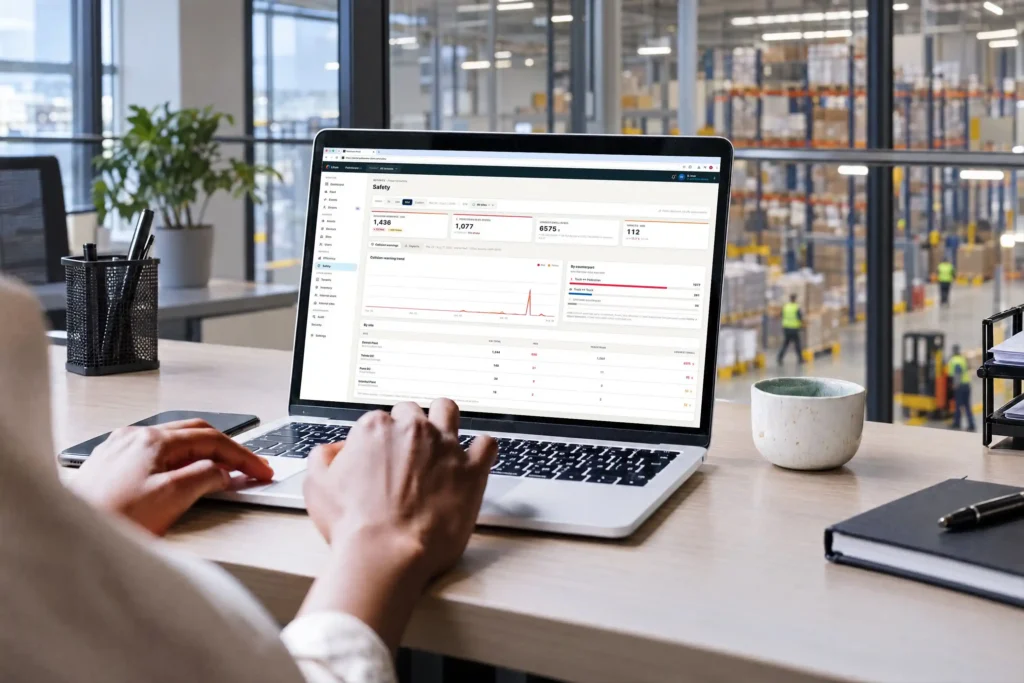
A system only closes the gap described above if it actually does the three things proactive safety requires: capture events automatically, tie them to something specific, and let patterns build up over time instead of resetting after every investigation. That is the layer PathAware® was built to add to forklift safety, structured so a company can grow into as much of it as the operation needs.
PathAware® Core is where that layer starts. It detects pedestrians, vehicles and obstacles around the forklift and warns the operator in real time, before a risk becomes a collision. That warning is valuable on its own, and for many fleets it is the first real upgrade their forklift safety has seen in years. It is also the foundation everything below builds on: a system already watching for risk on every covered vehicle, ready to do more the moment an operation is ready for it.
PathAware® IQ is where the proactive layer begins. Every alert becomes a logged event, tagged by severity so a real risk stands apart from routine noise, and tied to the vehicle, operator and shift it happened on. That is the leading-indicator data most safety programs never capture: not an isolated report filed after someone remembers a near miss, but a record built automatically, every time. Over time, that record is what lets a safety team see where near misses cluster, which operators or areas need attention, and whether corrective action is actually reducing risk, the pattern-finding work a paper-based process can rarely sustain.
PathAware® IQ+ extends that same intelligence into the two areas most reactive safety programs still handle on paper: pre-operation inspections and vehicle utilization. Inspections can be required before a shift starts, a reported defect notifies a supervisor immediately instead of waiting for a paper checklist to surface it, and the record stays open until it is resolved. IQ+ also shows how each forklift is actually used, including active time, idle time and usage patterns, giving operations teams a picture of where risk concentrates across a mixed fleet, information a near-miss investigation alone would never surface.
A single forklift can move from real-time collision warning to full inspection and utilization visibility without ever leaving the vehicle it already operates, and without a company committing to facility-wide infrastructure to get there. It is the difference between a safety program that waits for the next incident report and one that catches the near misses, the inspections and the usage patterns generating the risk in the first place.
Learn more about how PathAware® helps safety teams see risk before it becomes an incident.