

Table of Contents
Forklift pedestrian safety comes down to three things: keeping people and trucks apart wherever the layout allows, controlling the points where they must meet, and making sure both the operator and the person on foot know about the other in time to react. Training and signage matter, but they work best on top of a floor plan that removes most of the encounters in the first place.
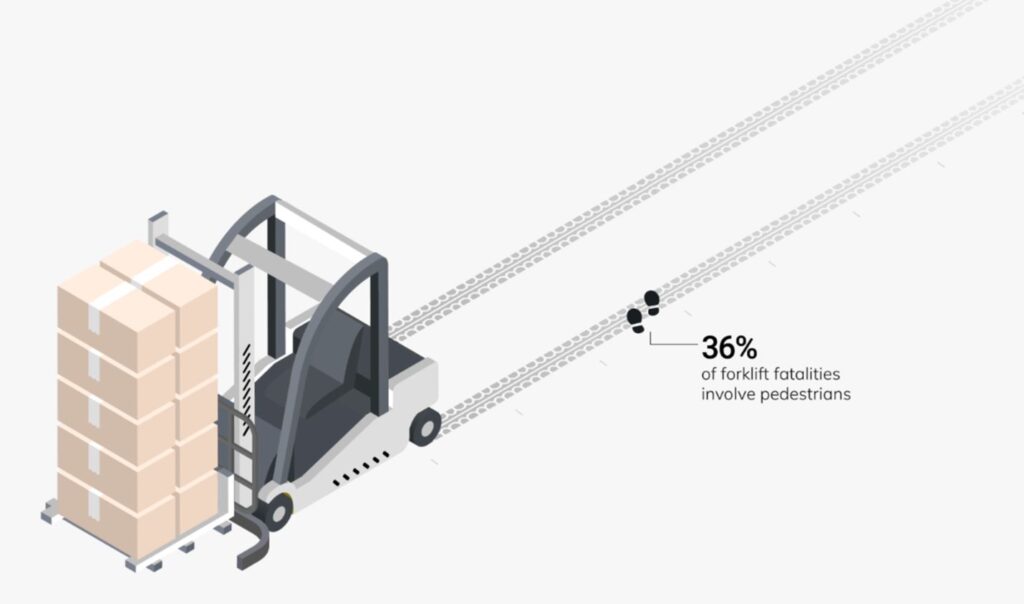
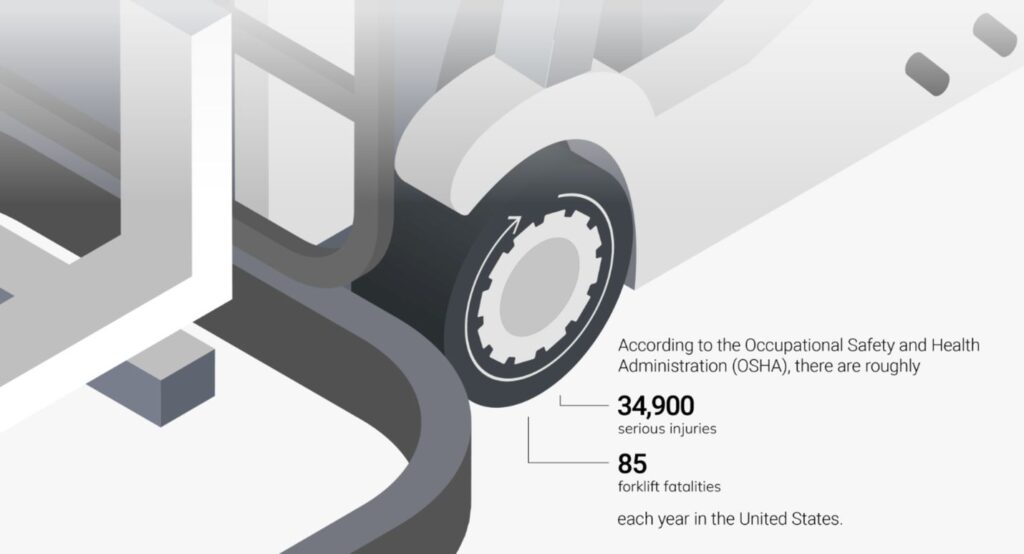
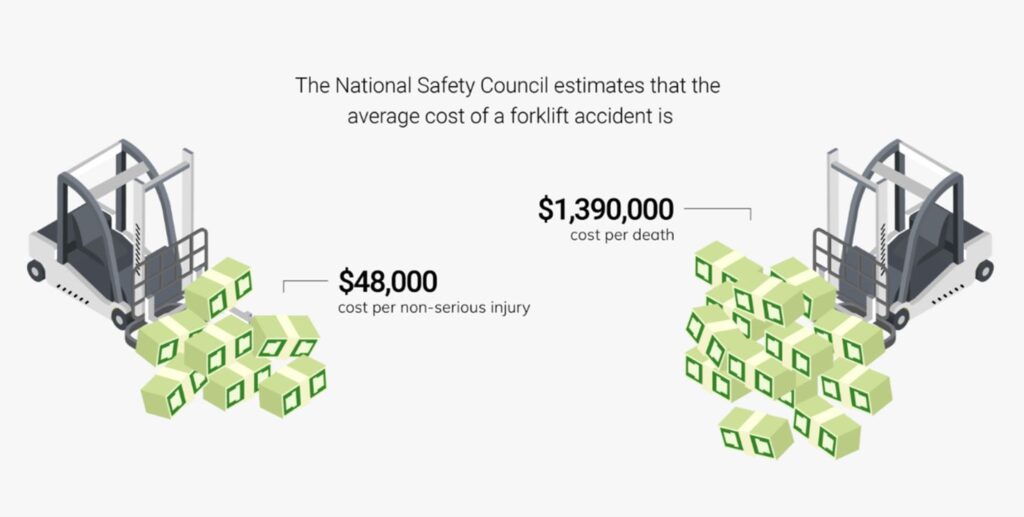
The stakes are measurable. According to the National Safety Council, forklifts were the source of 84 work-related deaths in the United States in 2024 and 25,110 injury cases involving days away, restricted work or job transfer in 2023 and 2024 combined. Many of those cases involve workers who were never operating a truck.
This guide covers what OSHA actually requires, the rules that are often misquoted (including the “3-foot rule”), and the controls that keep pedestrians safe in busy warehouses and plants.
Why Pedestrians Are the Most Exposed People on the Floor
A pedestrian has no frame, no overhead guard and no warning device of their own. Four conditions put them at risk in almost every facility:
- Blind spots are structural. The mast, the load and the overhead guard all block the operator’s view. A loaded truck often travels in reverse, so the operator relies on mirrors and a quick look over the shoulder.
- Noise hides the truck. Electric forklifts are quiet, and horns or backup alarms blend into ambient noise. Workers wearing hearing protection may not register a warning until the truck is already close.
- Counterbalance trucks swing wide. When a counterbalance forklift turns, its rear end swings outward. A person standing beside the truck can be struck by the back of the vehicle while the operator is watching the forks.
- Shared space grows under pressure. Peak season brings temporary staff, faster pick rates and more trucks per aisle. The number of forklift and pedestrian encounters rises exactly when attention is stretched thinnest.
For a closer look at how these incidents unfold, see forklift accidents and pathways to safer workplaces.
What OSHA Requires for Forklift and Pedestrian Safety
OSHA has no single “pedestrian rule” for forklifts. The obligations are spread across the powered industrial truck standard, 29 CFR 1910.178, and the materials handling standard, 29 CFR 1910.176. These are the provisions that protect people on foot:
Provision | What it requires | What it means on the floor |
|---|---|---|
1910.176(a) | Safe clearances for aisles, loading docks, doorways and turns; permanent aisles kept clear and appropriately marked | Marked walkways and travel lanes with enough width for both trucks and people |
1910.178(l)(3)(ii)(D) | Operator training must cover pedestrian traffic in the areas where the truck will be used | Site-specific training on where people walk, cross and work |
1910.178(m)(1) | Trucks shall not be driven up to anyone standing in front of a bench or other fixed object | No approaching a person who has nowhere to step away |
1910.178(m)(2) | No person may stand or pass under the elevated portion of a truck, loaded or empty | Keep everyone clear of raised forks and loads |
1910.178(n)(4) | Slow down and sound the horn at cross aisles and other locations where vision is obstructed; travel with the load trailing if it blocks the forward view | Intersections and blind corners are where speed drops |
1910.178(n)(6) | Look in the direction of travel and keep a clear view of the path | Reverse travel requires active looking, not mirrors alone |
1910.178(n)(8) | Operate at a speed that allows a safe stop under all travel conditions | Speed limits set by stopping distance, not by schedule |
OSHA’s pedestrian traffic eTool adds practical guidance: separate forklift traffic from other workers where possible, provide pedestrian walkways with permanent railings or barriers, and use floor striping where barriers cannot be installed. For how these rules are enforced and documented in 2026, see our guide to OSHA forklift regulations.
Is There an OSHA 3-Foot Rule?
No. The “3-foot rule” does not appear in 29 CFR 1910.178. It is an industry practice that many facilities write into their own policies, usually requiring people on foot to stay at least 3 feet away from an operating forklift. Some sites set a larger clearance, often 6 feet or more, for high-lift trucks, wide loads or narrow aisles.
The weakness of any fixed distance rule is that it depends on people judging distance correctly while both they and the truck are moving. A site policy works best when the distance is backed by physical separation, marked exclusion zones around the truck, or an alert that fires when someone crosses the threshold.
Who Has the Right of Way: Forklift or Pedestrian?
OSHA’s pedestrian traffic guidance tells operators to yield the right of way to pedestrians. In practice, that rule protects people only if pedestrians do not rely on it. A loaded forklift needs distance to stop, and an operator who cannot see a person cannot yield to them.
The safer site rule has two halves: operators always yield, and pedestrians always act as if the operator has not seen them. That means stopping at crossings, making eye contact with the operator and waiting for a clear signal before stepping into a travel lane.
Apply the Hierarchy of Controls to Forklift Traffic
The controls that remove encounters are more reliable than the ones that ask people to be careful. Work through them in this order:
- Separate. Route pedestrians away from forklift lanes. Put break rooms, restrooms and offices on walkways that never cross a travel lane. Schedule replenishment for times when pick areas are quiet.
- Engineer the meeting points. Use guardrails along walkways, gated or controlled crossings at main aisles, convex mirrors at blind corners and marked exclusion zones at docks and charging areas. These controls work without anyone remembering a rule.
- Set and enforce traffic rules. Speed limits by zone, one-way aisles where possible, horn and stop rules at intersections, and no riders. Post them where the rule applies, not only in the training room.
- Train both groups. Operators learn pedestrian traffic as part of their OSHA forklift certification. Pedestrians need their own briefing on blind spots, rear swing and crossing rules, including temporary staff and visitors.
- Increase visibility. High-visibility vests, adequate lighting and working truck lights help, but they are the last layer. They make people easier to see without reducing how often they meet a truck.
Safety Rules for Pedestrians
- Stay inside marked walkways and cross only at designated crossings.
- Stop at crossings and intersections, make eye contact with the operator and wait for a clear signal.
- Never walk or stand under raised forks or a raised load.
- Keep clear of the rear of a turning forklift.
- Avoid phones and paperwork while walking through active forklift areas.
- Never ride on a forklift unless the truck is designed and authorized for a passenger.
Safety Rules for Forklift Operators
- Yield to pedestrians, every time.
- Slow down and sound the horn at cross aisles, doorways and blind corners.
- Travel with the load trailing when it blocks the forward view, and look in the direction of travel.
- Never drive toward a person standing in front of a fixed object.
- Keep to zone speed limits and leave room to stop.
- Report near misses, even when nobody was hurt.
Where Technology Fits
Layout, rules and training remove most encounters. The ones that remain happen at blind corners, during reversing and when someone steps out unexpectedly, which is where people have the least time to react. This is where proximity alerts close the gap.
Litum’s forklift collision avoidance system, PathAware, mounts on the truck and detects pedestrians without requiring them to wear tags, so visitors and contractors are covered too. Operators get an in-cab warning showing the direction and distance of the hazard. Optional add-ons create safety zones at pedestrian crossings, slow the truck automatically in defined areas, and give selected workers wearable tags that vibrate when a truck approaches.
For a full comparison of detection methods, including camera-based and tag-based systems, see our forklift safety technology guide.
Forklift Pedestrian Safety in Practice
- Distribution center. Home Depot Mexico deployed Litum collision warning across 102 forklifts and 104 pedestrians, with alerts reaching both the operator and the worker on foot during peak season.
- Automotive manufacturing. A Fortune 500 automotive manufacturer combined collision alerts with forklift tracking across a 500,000 square foot plant section, improving operational efficiency by 35 to 55%.
Forklift Pedestrian Safety Checklist
- Walkways and travel lanes are marked and kept clear (1910.176(a))
- Main crossings have barriers, gates or controlled access
- Blind corners have mirrors and a slow-and-horn rule
- Exclusion zones are marked at docks, charging areas and racking work
- Zone speed limits are posted where they apply
- Operator training covers site-specific pedestrian traffic (1910.178(l)(3)(ii)(D))
- Pedestrians, temporary staff and visitors receive a forklift awareness briefing
- Near misses are reported and reviewed
- High-risk areas have proximity alerts for both operators and pedestrians
Frequently Asked Questions
What is the safe distance between a forklift and a pedestrian?
OSHA does not set a fixed distance between a forklift and a pedestrian. It requires safe clearances in aisles and passageways, forbids driving toward a person standing in front of a fixed object, and keeps people out from under raised forks. Many facilities set their own minimum, commonly 3 feet, and increase it for high-lift trucks, wide loads or narrow aisles.
What is the 3-foot rule for forklifts?
The 3-foot rule is a common workplace policy that asks pedestrians to stay at least 3 feet from an operating forklift. It is not written in OSHA’s forklift standard. Because it depends on people judging distance while moving, it works best when backed by marked zones, barriers or proximity alerts.
What are the OSHA guidelines for pedestrian safety around forklifts?
OSHA requires marked, clear aisles with safe clearances (29 CFR 1910.176(a)), operator training that covers pedestrian traffic, slowing down and sounding the horn at obstructed intersections, and keeping people out from under raised loads (29 CFR 1910.178). OSHA’s eTool also recommends separating forklift and pedestrian traffic with walkways, barriers or floor striping.
Do pedestrians have the right of way over forklifts?
OSHA guidance tells forklift operators to yield the right of way to pedestrians. Pedestrians should still act as if the operator has not seen them: stop at crossings, make eye contact and wait for a clear signal, because a loaded forklift cannot always stop in time.
How should a pedestrian approach a forklift?
Stay outside the truck’s path and wait until the operator sees you, makes eye contact and brings the forklift to a full stop. Approach from the side the operator can see, keep your feet clear of the wheels and step away before the truck moves again.
Want to see where forklifts and pedestrians meet in your facility? Get a free assessment from Litum’s forklift safety team.