

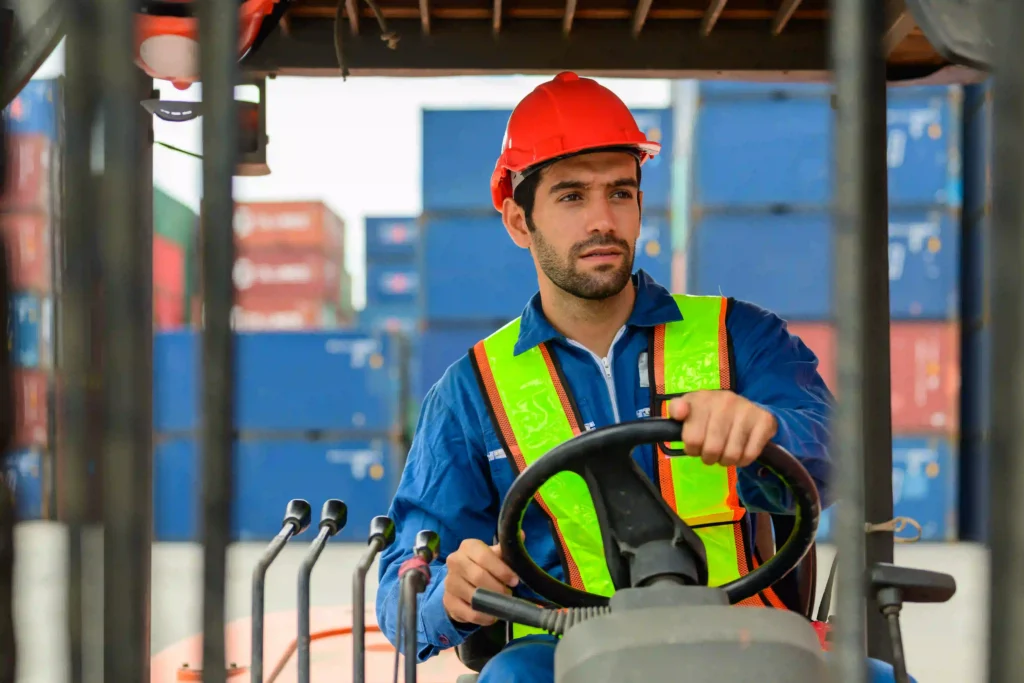
Distribution centers are demanding environments on a good day. During peak seasons, the pace picks up, teams expand, and the density of activity across aisles, docks, and loading areas increases significantly. Forklifts and on-foot workers share the same spaces, often moving quickly and with limited visibility around blind corners and busy intersections.
In that kind of environment, awareness is a safety concern and an operational one. A near-miss slows everything down. An incident stops it entirely.
Home Depot Mexico recognized this reality and looked for a solution that could keep pace with their operations, not just during quiet periods, but precisely when things get hectic.
“Litum’s collision warning technology has helped us prevent collisions and accidents, particularly during peak seasons when our teams are moving quickly and operations are under pressure. It helps us stay aware of potential risks and avoid accidents.”
Iván Díaz, Maintenance Manager, Home Depot Mexico
The Challenge: Forklift Pedestrian Safety That Has to Hold During Peak Seasons
At high-traffic distribution sites, the risk of forklift-related incidents doesn’t come from negligence. It comes from the inherent complexity of the environment. According to the National Institute for Occupational Safety and Health, forklift incidents cause dozens of fatalities each year in the United States, with pedestrian workers consistently among those most at risk.
Operators working fast may not catch every pedestrian stepping into a travel path. Workers on foot can’t always hear an approaching forklift over ambient noise. Blind spots are structural, not a matter of attention.
For Home Depot Mexico, the question wasn’t whether their teams were careful. It was whether their safety infrastructure was giving people the information they needed, in time to act on it.
The Solution: A Pedestrian Detection System Ready from Day One
Litum’s forklift collision warning system was deployed across Home Depot Mexico’s distribution operations to monitor forklift movement and flag dangerous proximity in real time, covering 102 forklifts and 104 pedestrians.
The system is tag-based and plug-and-play: no complex installation, no cameras, no dependence on line-of-sight detection. It mounts directly to the forklift, runs on the vehicle’s own battery, and is operational immediately after setup. Distance thresholds are fully configurable to match the specific layout and flow of each facility.
How the Pedestrian Alert System Works
When a forklift and a pedestrian come into proximity, the
system issues alerts across two configurable thresholds:
1. Caution alert: gives both parties time to adjust
before a situation develops.
2. Danger alert: fires at closer range, when
immediate action is required.
The forklift operator receives audiovisual warnings. The pedestrian’s wearable tag vibrates to signal nearby vehicle activity. Whether someone enters the caution zone gradually or appears suddenly within the danger threshold, the right alert fires immediately. That layered approach is what gives people enough time to act, regardless of how a situation develops.
Unlike most pedestrian alert systems on the market, which only warn the forklift driver, Litum’s approach alerts both sides simultaneously, giving every person in the facility a chance to react, regardless of who notices the hazard first.

Where It Makes a Difference
The value of a pedestrian safety system is proven when operations are at their most demanding. For Home Depot Mexico, Litum’s solution has demonstrated its effectiveness precisely where it matters most: during the periods when warehouse traffic increases and the stakes are highest.
The system performs consistently across three high-pressure scenarios:
- Awareness where operators can’t see. The system detects proximity even around blind corners and in areas with obstructed sightlines. Operators don’t need to rely solely on mirrors or intuition. The system alerts them before a situation becomes a near-miss.
- Alerts that reach both sides. Most collision warning systems only alert the forklift driver. Litum’s approach alerts the pedestrian directly as well, through tactile vibration, giving both parties the chance to react, regardless of who notices first.
- Reliability under operational pressure. Peak season doesn’t just increase traffic. It often means newer team members, unfamiliar layouts, and a faster pace. A system that performs consistently under those conditions is a fundamentally different asset than one that works only in controlled circumstances.
A Modular Platform That Grows With You
Litum’s forklift collision warning system is built to grow alongside an operation. The foundation is standalone collision warning and real-time proximity alerts. From there, facilities can layer in:
- Automated speed control that slows forklifts when they enter high-risk zones.
- Geofencing that triggers alerts or actions based on specific areas of the facility.
- Full forklift tracking with dashboards and fleet analytics for complete visibility across your operation.
Each capability builds on the last, and expanding the system doesn’t mean replacing what’s already in place.
Proven at Scale, Ready for Your Facility
Litum has equipped more than 16,000 forklifts across deployments in over 50 countries, with all hardware, firmware, and software developed and manufactured in-house. That end-to-end ownership means faster customization, consistent quality, and a single point of accountability from installation through ongoing support.
Frequently Asked Questions: Forklift Pedestrian Safety
What are the OSHA regulations for forklifts and pedestrians?
OSHA standard 29 CFR 1910.178 requires employers to establish safe speeds, enforce right-of-way rules for pedestrians, and maintain clearly marked traffic lanes wherever forklifts and on-foot workers share the same space. Operators must also be trained and certified. This standard accounts for more than 2,600 violations annually, making it one of the most frequently cited in general industry. Proximity warning systems like Litum’s support compliance by giving both operators and pedestrians real-time alerts before a hazard develops. OSHA fines for willful violations can reach $156,259 per incident.
How should a pedestrian approach a forklift?
Pedestrians should never assume a forklift operator can see them. Blind spots around the mast, forks, and corners are structural. Before entering any area where forklifts operate, a pedestrian should make eye contact with the operator, wait for the forklift to come to a complete stop, and only then cross the travel path. In facilities using a pedestrian alert system like Litum’s, wearable tags vibrate to warn workers of approaching vehicles before they can be seen or heard, providing an additional layer of pedestrian safety.
What is the forklift 3-foot rule?
The 3-foot rule is a widely applied safety practice requiring pedestrians to maintain a minimum 3-foot clearance from an operating forklift at all times. Some facilities extend this to 6 feet or more depending on load size and aisle width. The challenge is that this rule depends on visual judgment, which breaks down in high-traffic environments and around blind corners. Technology-based pedestrian safety systems enforce a configurable safe distance automatically, triggering alerts the moment a pedestrian enters within the defined threshold.
What are 5 forklift safety rules every facility should follow?
- Keep pedestrians out of the travel path at all times, especially near racks and blind corners.
- Slow down at intersections: audible signals help, but speed reduction is the primary safeguard.
- Never exceed the safe speed limit for your facility. Most indoor distribution centers set this at 5 mph or lower.
- Ensure loads do not block the operator’s sightlines. Oversized loads should be carried in reverse or with a spotter.
- Use a pedestrian detection system. Technology that alerts both the operator and the pedestrian removes the dependency on line-of-sight awareness and covers the gaps that training alone cannot.
For a full breakdown of OSHA requirements for powered industrial trucks, visit the official OSHA powered industrial trucks page.