

Table of Contents
OSHA forklift regulations are entering 2026 under heavier enforcement than the standard itself has seen in years. The core rule has not changed, what changed is how aggressively it is enforced and what inspectors expect to see the moment they walk in.
The 2026 Enforcement Landscape at a Glance
The regulation itself has not changed much. What changed is how aggressively it is enforced and what inspectors expect to see when they arrive.
29 CFR 1910.178 remains the governing standard for powered industrial trucks, covering operator training, daily inspections, maintenance, fuel handling, and battery charging. None of those obligations are new. What is new in 2026 is the enforcement infrastructure built around them: two active National Emphasis Programs authorize unannounced inspections at warehouses and distribution centers, penalty maximums have climbed to record levels, and a federal heat standard is moving toward final rule status.
The pattern across all of it points one direction. OSHA increasingly expects records to be digital, timestamped, and producible on demand. A facility that cannot pull up operator certifications, pre-shift inspection logs, and maintenance histories within minutes of an inspector walking in is starting the inspection at a disadvantage, regardless of how safe its actual operations are.
Penalty Structure: What Non-Compliance Costs Now
As of the most recent adjustment, OSHA penalty maximums stand at $16,550 per serious violation and $165,514 for willful or repeated violations. A single comprehensive inspection that surfaces multiple documentation gaps can stack citations quickly, a missing daily inspection log, an expired operator evaluation, and an unventilated charging area are three separate violations, not one.

The July 2025 Field Operations Manual update also restructured how penalty reductions work, and the changes reward exactly the kind of operational discipline that digital systems make easy:
Small businesses with up to 25 employees now qualify for reductions up to 70 percent, expanded from the previous 10-employee threshold. A new Quick-Fix credit of 15 percent applies when hazards are corrected immediately. A clean inspection history over five years earns an additional 20 percent reduction.
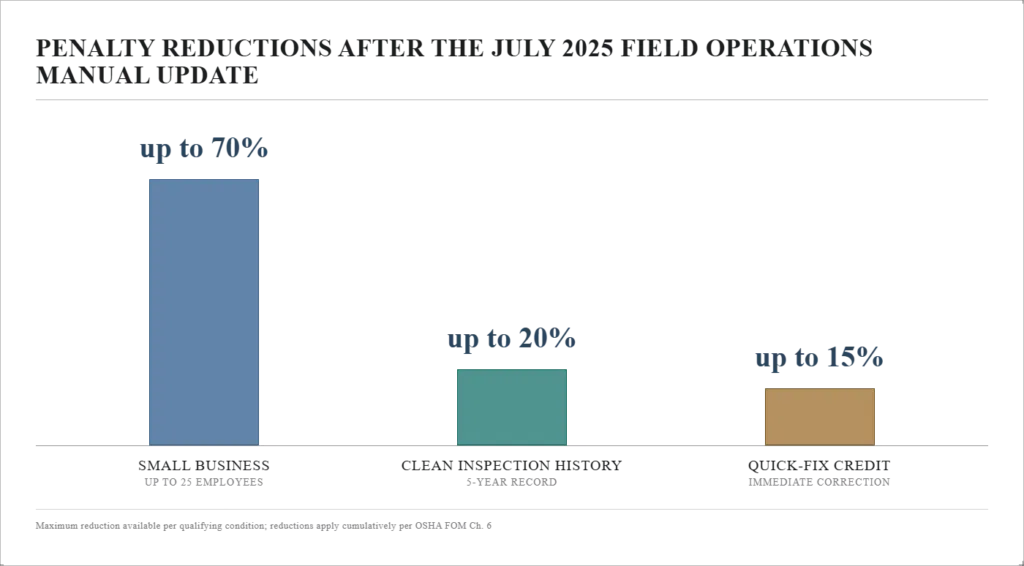
Read together, the message is clear: the cost of gaps went up, and the reward for demonstrable, documented correction went up with it.
Active Enforcement Programs Targeting Forklift Operations
The Warehousing National Emphasis Program
The Warehousing and Distribution Center NEP (CPL 03-00-026) authorizes programmed, unannounced inspections at facilities selected by NAICS code and injury rate data, no complaint or incident required. Facilities with DART rates above private industry baselines are on the target list.
These inspections are comprehensive by design. Inspectors review powered industrial truck operations alongside material handling, walking-working surfaces, emergency egress, and fire protection in a single visit. For forklift operations specifically, the items requested most consistently are operator training records, certification and evaluation documentation, daily pre-shift inspection logs, and equipment maintenance histories.
The program runs through mid-2026, and the practical implication is straightforward: every covered facility should operate as though an inspection could begin tomorrow morning.
The Heat NEP and Indoor Operations
The Heat NEP (CPL 03-00-024), extended through April 2026, covers indoor warehouse environments, not just outdoor work. OSHA can initiate inspection activity when the heat index reaches 80°F, which many warehouse interiors exceed routinely near charging areas, compressors, and poorly ventilated zones.
In parallel, OSHA’s proposed Heat Injury and Illness Prevention Standard would make written prevention plans, acclimatization protocols for new workers, and environmental monitoring permanent requirements. The rule is not final, but facilities are already being cited under the General Duty Clause for heat hazards the proposed standard describes. Forklift operators working near heat-generating equipment sit directly in this exposure zone.
Core Compliance Areas Under 29 CFR 1910.178
Operator Certification, Not Licensing
A recurring point of confusion: OSHA does not issue forklift licenses. What the standard requires is employer-administered certification, formal instruction, a practical skills evaluation, and documented assessment for each vehicle class the operator uses. Recertification runs on a three-year cycle, with immediate re-evaluation triggered by incidents, observed unsafe operation, or assignment to an unfamiliar truck type. Our full guide on OSHA forklift certification covers the training and evaluation process in detail.
Daily Inspections and Maintenance Records
The standard requires pre-shift examination of every truck in service, with defective equipment removed from service immediately. During Warehousing NEP inspections, this is one of the most commonly cited gaps, not because facilities skip inspections, but because paper-based records are incomplete, illegible, or cannot be located when requested. A missing log is treated the same as a missed inspection.
Battery Charging and Fuel Handling Areas
Charging station requirements are among the most frequently overlooked obligations in the standard. Battery charging areas must be equipped with fire prevention equipment, adequate ventilation, and protection against acid splash. Fuel handling for LPG, diesel, and gas units must follow NFPA standards. Bureau of Labor Statistics data continues to show fire and explosion events as a persistent injury cause in material handling environments, which keeps these areas high on inspector checklists.
Autonomous Vehicles and the ANSI B56.5 Shift
Facilities running AGVs or AMRs alongside human-operated forklifts face a compliance dimension that barely existed when the current standard was written. OSHA has proposed incorporating ANSI/ITSDF B56.5, the consensus standard for driverless industrial vehicles, into its powered industrial truck requirements, replacing references that date to 1969.
ANSI B56.5 covers obstacle detection and braking, minimum guide path clearances, hazard zone marking, and emergency stop functionality. For mixed fleets, the operative requirement is continuous awareness of where every vehicle and every pedestrian is, because clearance and zone rules cannot be enforced without knowing positions in real time. What was best practice for early AGV adopters is on track to become codified regulation.
How Real-Time Tracking Closes the Documentation Gap
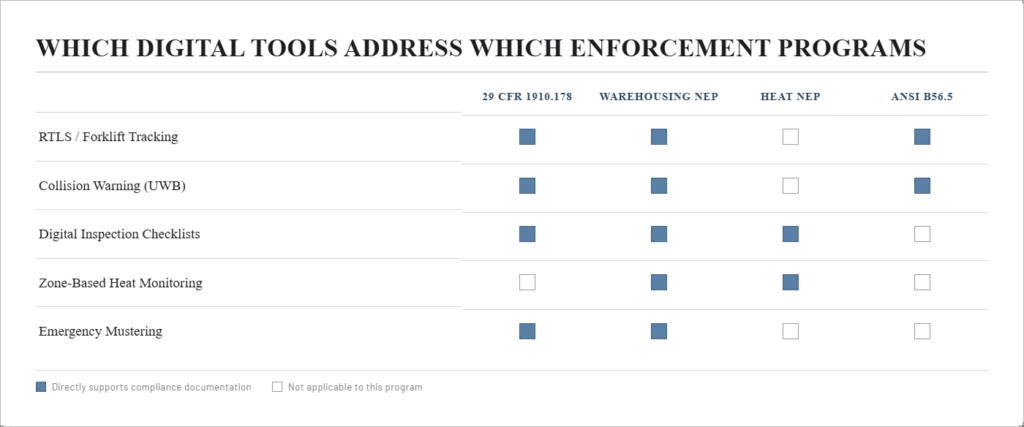
Every enforcement program described above converges on the same operational need: continuous, automatic, auditable records of where vehicles operate, how they are used, and whether safety rules were followed. This is precisely what real-time location systems produce as a byproduct of normal operation.
A UWB-based forklift tracking deployment records vehicle paths, speeds, and zone activity continuously, generating the audit trail Warehousing NEP inspectors expect without anyone filling out a form. Collision warning systems enforce safe separation between forklifts and pedestrians through proximity alerts and geofenced speed zones, directly supporting the clearance logic that ANSI B56.5 formalizes, and logging every intervention as a timestamped event.
The same infrastructure extends to the human side of compliance. Connected worker systems monitor personnel in high-risk zones, and zone-based monitoring can flag extended worker presence in high-temperature areas, supporting the environmental documentation the Heat NEP and the proposed federal standard call for. During an evacuation, emergency mustering confirms headcount in seconds with a digital record of who reached the assembly point and when.
For operations evaluating where to start, the compliance case and the safety case point to the same first step: instrument the vehicles. Litum’s PathAware forklift safety system combines collision prevention with the continuous documentation layer that 2026 enforcement expects. Explore Litum’s industrial case studies to see how facilities have deployed it.
Frequently Asked Questions
Can OSHA inspect my warehouse without warning?
Yes. Under the Warehousing NEP, OSHA conducts programmed unannounced inspections at facilities selected by industry code and injury rates. No complaint, referral, or incident is needed to trigger one, and the inspection scope covers all major hazard categories, not just the selection criteria.
Is there an OSHA forklift license?
No. OSHA requires employer-administered operator certification: formal training, practical evaluation, and documented assessment under 29 CFR 1910.178, renewed every three years or immediately after an incident, observed unsafe behavior, or reassignment to a different truck type.
What do inspectors ask for first during a forklift-related inspection?
Operator training and certification records, daily pre-shift inspection logs, and maintenance documentation are the most consistently requested items. Facilities using paper systems most often receive citations for records that exist but cannot be produced completely on demand.
Do the heat rules really apply inside a warehouse?
Yes. The Heat NEP explicitly covers indoor environments, and inspection activity can begin when the heat index reaches 80°F. Areas near battery charging stations, compressors, and dock doors in warm climates routinely cross this threshold.
What does ANSI B56.5 mean for facilities without AGVs?
Nothing immediately. But for any facility planning automation, the proposed incorporation of B56.5 into OSHA’s standards means AGV deployments should be designed around its clearance, detection, and zone marking requirements from day one rather than retrofitted later.
How does a forklift tracking system help with OSHA compliance specifically?
It converts compliance from manual record-keeping into automatic documentation. Vehicle paths, speed zone adherence, proximity events, and operator activity are logged continuously and timestamped, producing exactly the auditable digital records that current enforcement programs expect facilities to present during inspection.