



GPS is the default answer for location tracking outdoors. But inside a warehouse, hospital, or industrial facility, GPS signals degrade or fail entirely. That is where indoor positioning systems take over, and Bluetooth Low Energy (BLE) is one of the most widely deployed technologies behind them.
BLE indoor positioning uses small, low-energy Bluetooth beacons and receivers to determine the location of tagged assets, equipment, or people inside indoor spaces. Combined with RTLS software, it creates a real-time picture of where everything is, without relying on GPS, Wi-Fi, or cellular signals.
This guide explains what BLE indoor positioning is, how it works, where it performs best, and how it compares to other indoor positioning technologies. For a broader overview of real-time location systems, see our guide on what RTLS is and how it works.
What Is BLE Indoor Positioning?

BLE indoor positioning is a method of determining the location of people, assets, or equipment inside indoor environments using Bluetooth Low Energy signals. BLE beacons, small wireless devices, broadcast signals at regular intervals. Receivers or BLE tags pick up these signals, and a location engine calculates position based on signal strength, timing, or a combination of both.
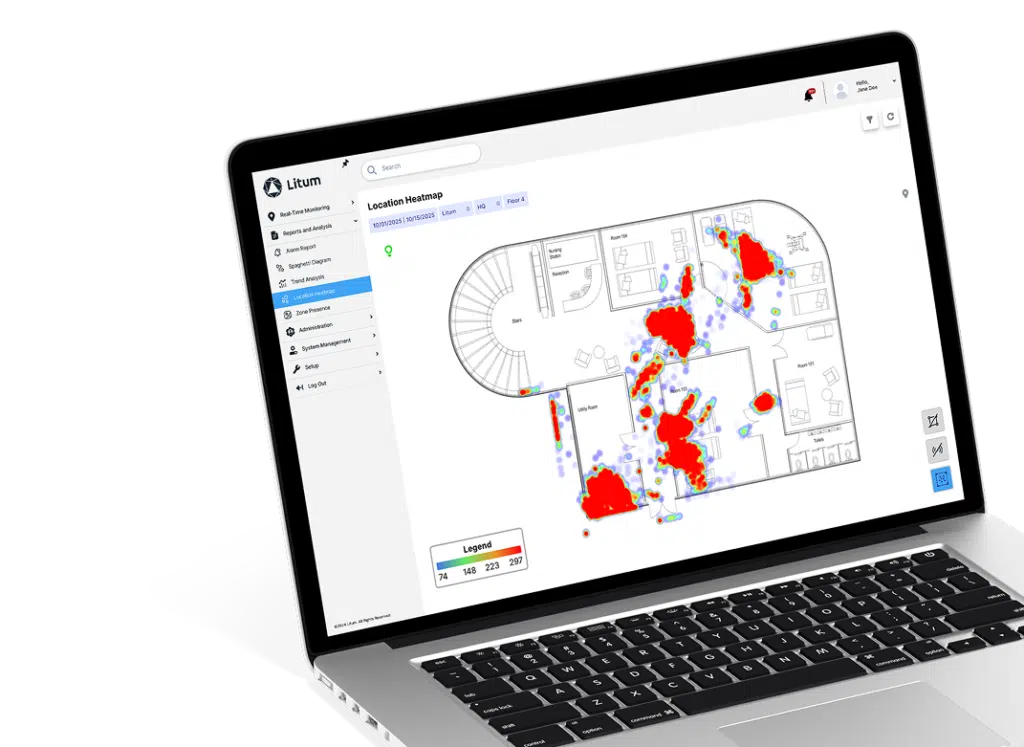
The result is an indoor positioning solution that provides real-time location data for every tagged item or person on a digital map. This data feeds into RTLS software for live dashboards, alerts, movement history, and analytics.
BLE indoor positioning is used across industrial spaces, healthcare facilities, warehouses, airports, and any large indoor facility where knowing where things are has operational value. According to market trend research, the indoor location market is growing rapidly as businesses seek real-time location intelligence across their operations.
BLE RTLS: The Full Picture
When BLE indoor positioning is combined with RTLS software, it becomes a Bluetooth RTLS: a complete real-time location system powered by Bluetooth technology. The system tracks not just where something is, but how long it has been there, where it has been, and what patterns emerge over time. This time location data is what separates a simple positioning system from a full operational intelligence platform.
What Is Bluetooth Low Energy (BLE)?
Bluetooth Low Energy, or BLE, is a wireless communication standard designed for low energy levels and short-to-medium range data transmission. It was introduced as part of the Bluetooth 4.0 specification and is governed by the Bluetooth Special Interest Group (Bluetooth SIG), the organization that sets Bluetooth standards globally.
BLE was created for IoT applications where devices need to communicate frequently without draining batteries. A BLE beacon can run for months or years on a small coin cell battery, which is a critical factor for large-scale deployments where replacing batteries across hundreds of devices needs to be practical.
The key characteristics of BLE technology are:
- Low energy consumption: BLE devices broadcast at energy levels far below standard Bluetooth, extending battery life significantly
- Short to medium range: typical BLE range is 10 to 30 meters indoors, with some hardware reaching further depending on environment and antenna design
- High device density: BLE works well in environments with large numbers of wireless devices broadcasting in the same space
- Compatibility: BLE is supported natively in smartphones, tablets, and most modern mobile devices, making it easy to use existing hardware as receivers
For a more technical overview of BLE signal characteristics and factors affecting performance, EDN’s BLE primer provides detailed coverage of the protocol’s physical layer.
How BLE Indoor Positioning Works
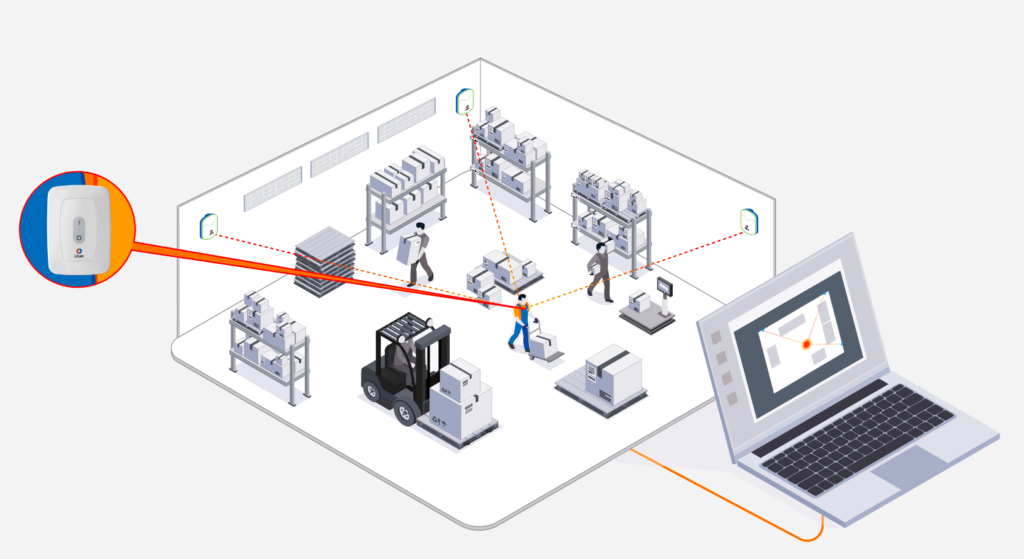
BLE indoor positioning works through a combination of hardware (beacons and receivers) and software that processes signal data into location information.
The BLE Positioning Process
There are three core methods used for BLE positioning, each suited to different accuracy and deployment needs:
RSSI-Based Positioning
The most common BLE positioning method uses Received Signal Strength Indicator (RSSI). A BLE tag or beacon broadcasts a signal. Multiple receivers pick up the signal and measure its strength. The location engine uses the strength readings from several receivers to estimate the tag’s position through trilateration.
RSSI-based positioning delivers zone-level to room-level accuracy, typically 2 to 5 meters. This is sufficient for most asset tracking and personnel tracking use cases in warehouses and hospitals.
Angle of Arrival (AoA) Positioning
Angle of Arrival uses directional antenna arrays to measure the angle from which a BLE signal arrives at a receiver. By combining AoA readings from multiple receivers, the system calculates a more precise location.
Bluetooth Special Interest Group (Bluetooth SIG) introduced direction finding capabilities including AoA in the Bluetooth 5.1 specification, significantly improving the precision available from BLE-based indoor positioning systems.
Proximity Detection
The simplest form of BLE positioning is proximity detection: determining whether a tagged item is near a specific beacon or zone. This is used for entry/exit logging, zone compliance, and attendance management where room-level or zone-level location is sufficient rather than precise location data.
From BLE Signals to Location Data
Raw BLE signals pass from hardware to a location engine, which is software that applies algorithms to convert signal data into coordinates or zone assignments on a facility map. The location engine connects to RTLS software, which presents the data in live maps, dashboards, and reports. This software layer is where time location tracking, analytics, and integration with other systems happen.
BLE Beacons and Tags: Key Hardware Components
BLE Beacons
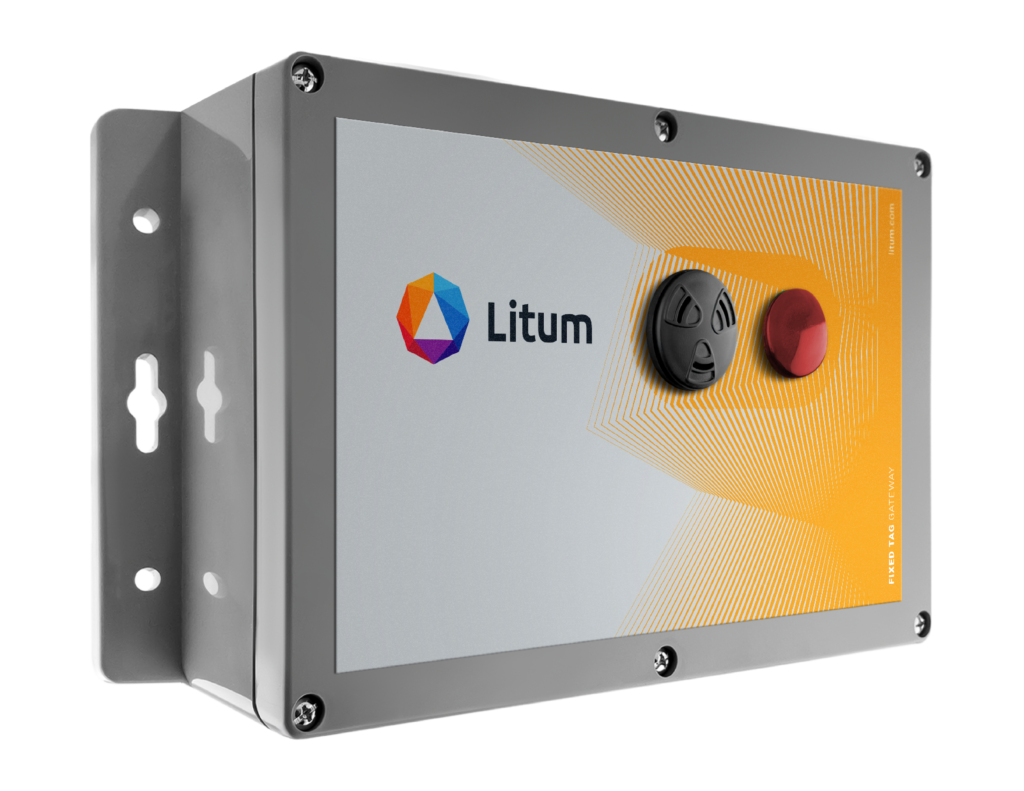
BLE beacons are fixed hardware devices installed throughout a facility. They broadcast BLE signals at regular intervals. In some architectures, beacons are the fixed reference points installed on ceilings or walls, and mobile tags attached to assets or worn by people receive and report signal data. In others, beacons transmit and fixed receivers (gateways or anchors) listen.
Beacons are compact devices, with many manufacturer models measuring just a few centimeters in each dimension, and they can be installed on standard mounting hardware. Battery life ranges from several months to several years depending on broadcast interval settings and environment.
BLE Tags
BLE tags are mobile devices attached to assets, worn by personnel, or embedded in ID badges. A BLE tag broadcasts its identity at regular intervals. When receivers pick up the signal, the system logs the tag’s location. BLE tags are available in many form factors: wearable badges, hard tags for equipment, and labels for smaller assets. A BLE tag consumes very little power, making it practical for large deployments across many assets.
Gateways and Receivers
Gateways or receivers are fixed devices installed across the facility that receive BLE signals from mobile tags. They pass the signal data, including signal strength and timing, to the location engine for processing. The density and placement of receivers directly affects positioning accuracy: more receivers covering the same space produces more precise location data.
RTLS Software and Dashboards
The hardware layer feeds into RTLS software that processes location data, maintains movement history, generates analytics, and presents everything in live dashboards. The software handles integration with other systems (ERP, WMS, CMMS) and provides the reporting layer that turns raw location data into operational intelligence.
BLE Positioning Accuracy: What to Expect
BLE indoor positioning accuracy depends on the method used, the hardware quality, the density of receivers, and the physical environment.
Accuracy by Positioning Method
- RSSI-based BLE: 2 to 5 meters typical. Zone-level or room-level accuracy. Good for most asset tracking and personnel tracking use cases
- AoA BLE (Bluetooth 5.1+): AoA BLE (Bluetooth 5.1+): Improved accuracy over standard RSSI-based BLE. For use cases where sub-meter precision is critical, UWB RTLS is the more reliable and purpose-built solution.
- Proximity BLE: Zone-level detection only. Useful for entry/exit logging and zone compliance where precise location data is not required
Environmental Factors Affecting Accuracy
Indoor environments create challenges for all radio-based positioning. Walls, metal structures, dense equipment, and high volumes of wireless devices all affect BLE signal propagation. Receiver placement and density are the key factors in any BLE deployment and have the most direct impact on the level of accuracy achieved in real-world conditions.
For use cases where sub-meter precision is critical, such as precise tool tracking in manufacturing or fine-grained location in crowded hospital environments, UWB positioning or a hybrid BLE and UWB architecture may be more appropriate. See our guide on RTLS technologies for a full comparison.
BLE RTLS vs. Other Indoor Positioning Technologies
Several technologies compete and cooperate in the indoor positioning space. Understanding how BLE compares to other systems helps organizations choose the right approach for their specific use case.
BLE vs. UWB (Ultra-Wideband)
Ultra-wideband (UWB) uses very short radio pulses across a wide frequency spectrum to achieve precise time-of-flight measurements. UWB delivers sub-meter accuracy, often 10 to 30 cm, and is less affected by multipath interference in complex indoor environments. The FCC formally allocated spectrum for UWB devices, supporting its use in commercial location applications.
UWB provides higher accuracy than standard BLE but requires dedicated hardware and is typically deployed where precision tracking is critical. BLE is better suited for broad area coverage where zone-level to room-level accuracy is sufficient and cost efficiency matters. Many enterprise deployments use both: BLE for wide-area tracking and UWB positioning or UWB RTLS for high-precision zones.
BLE vs. Wi-Fi
Wi-Fi-based indoor positioning uses existing Wi-Fi access points to estimate device location via signal strength. Coverage is broad where Wi-Fi is already deployed. Accuracy is lower than BLE in most configurations, typically 5 to 15 meters, and Wi-Fi positioning adds load to network infrastructure. BLE dedicated infrastructure provides better accuracy and more predictable performance for real-time location tracking.
BLE vs. RFID
RFID provides identification at specific checkpoints: it tells you what an asset is when it passes a reader, not where it is in real time. BLE provides continuous, active positioning across a facility. For organizations that need real-time location data rather than checkpoint-based events, BLE RTLS delivers more operational value than passive RFID tracking. Many deployments use both: RFID for entry/exit identification and BLE for continuous indoor tracking.
Omlox and Interoperability
Omlox is an open interoperability framework for industrial RTLS that supports multiple positioning technologies including UWB and BLE. Omlox allows organizations to combine different RTLS technologies and vendors on shared infrastructure, which is a relevant consideration for businesses planning multi-technology indoor positioning architectures.
BLE Indoor Positioning Applications
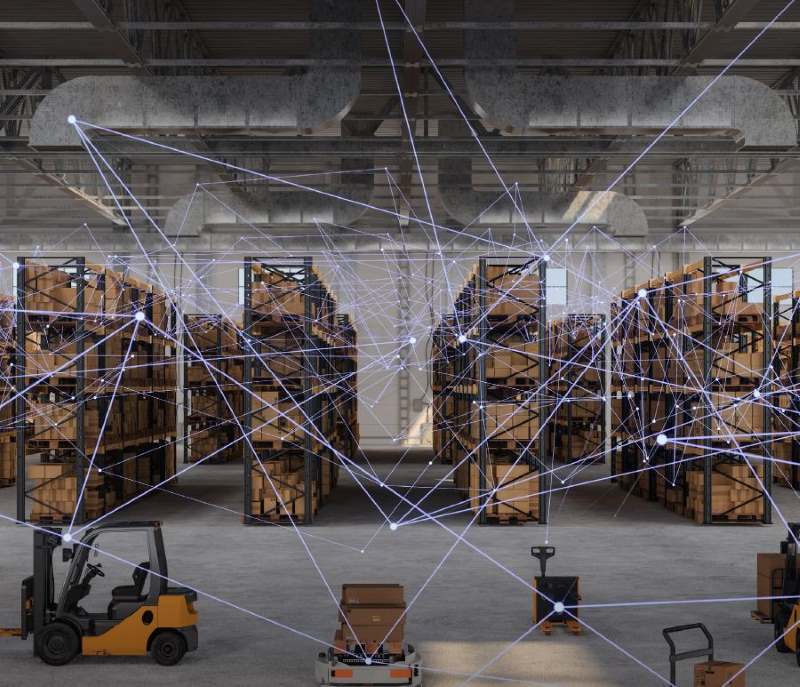
BLE indoor positioning creates value across industries wherever real-time knowledge of asset or personnel locations improves safety, efficiency, or compliance.
Asset Tracking Applications
BLE asset tracking is one of the most common applications of indoor positioning systems. In industrial spaces and warehouses, BLE tags on forklifts, tools, containers, and equipment provide live location data. Staff spend less time searching for assets. Utilization data shows which assets are idle, supporting right-sizing decisions. For more on how RTLS supports asset tracking across industrial environments, see Litum’s asset tracking solutions.
Worker Safety Applications
BLE RTLS supports worker safety by tracking personnel locations in real time. Zone compliance alerts notify supervisors when workers enter restricted or hazardous areas. Lone worker monitoring uses BLE positioning to detect workers who have not moved for an unusual period of time, triggering automated alerts for immediate response. The U.S. Bureau of Labor Statistics consistently ranks manufacturing and industrial work among the highest-injury occupational categories, underscoring the value of technology-driven safety monitoring.
Emergency Mustering
BLE indoor positioning significantly improves emergency mustering accuracy. During an evacuation, the system generates a live headcount based on tag detection at or near the muster point. Coordinators see in real time who is accounted for and where unaccounted individuals were last detected, enabling a faster, more accurate response. For more on how RTLS supports emergency mustering, see Litum’s emergency mustering solution.
Forklift and Vehicle Tracking
In warehouses and manufacturing facilities, BLE positioning tracks forklift and vehicle locations in real time. Combined with geofencing, the system enforces speed zones and restricted areas, reducing the risk of collisions with pedestrians. OSHA identifies powered industrial trucks as a leading cause of workplace fatalities, and BLE-based proximity tracking is one of the most effective tools for reducing this risk. See Litum’s forklift tracking solution for more detail.
Cases of RTLS Across Industries
The cases of RTLS deployment across manufacturing, logistics, healthcare, construction, and energy sectors share a consistent pattern: organizations start with one use case, typically asset tracking or worker safety, and expand to additional applications on shared BLE infrastructure. This is one of the key advantages of BLE RTLS: a single hardware deployment supports multiple use cases without separate systems for each.
BLE RTLS in Healthcare
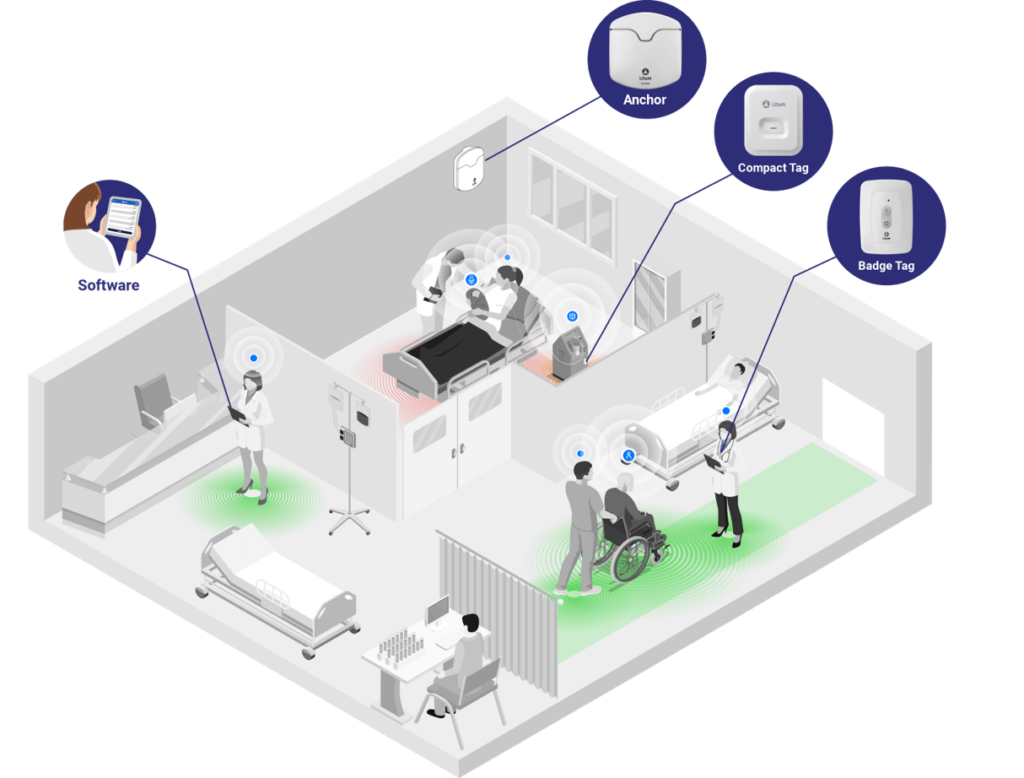
Healthcare is one of the highest-value environments for BLE indoor positioning. Hospitals are large, complex indoor spaces with thousands of pieces of medical equipment, hundreds of staff, and patients whose safety depends on rapid response.
Medical Equipment Tracking
Clinical staff spend significant time searching for misplaced medical equipment: beds, infusion pumps, ventilators, wheelchairs, and portable monitors. BLE tags on equipment provide live location data on a digital map, eliminating search time and improving equipment utilization. For a full overview of healthcare RTLS capabilities, see Litum’s healthcare RTLS platform.
Patient Flow
BLE positioning supports patient flow management by tracking patient movement from admission through discharge. Real-time location data reveals bottlenecks, showing where patients are waiting and for how long, giving operations teams the information they need to reduce wait times and improve care throughput.
Staff Safety in Healthcare
Healthcare worker safety is a critical application of BLE RTLS. Staff duress systems use BLE badges to allow healthcare workers to trigger an alert with their precise location data in emergency situations. The system notifies security teams with the staff member’s location, enabling rapid response. See Litum’s staff duress solution for more.
Analytics for Healthcare Operations
Beyond real-time tracking, BLE RTLS software generates analytics on equipment utilization, staff workflow patterns, and patient flow. These analytics support better staffing decisions, procurement planning, and continuous improvement in care delivery. According to Gartner’s Market Guide for Indoor Location Services, indoor location analytics is one of the fastest-growing investment areas in healthcare operations technology.
Benefits of BLE Indoor Positioning Systems
Cost-Efficient Infrastructure
BLE hardware (beacons, tags, and gateways) is widely available and competitively priced at scale. Many facilities can use existing smartphones and mobile devices as BLE receivers, reducing infrastructure investment further. The low energy consumption of BLE devices keeps ongoing battery and maintenance costs manageable across large deployments.
Scalable Across Indoor Spaces
BLE indoor positioning scales from a single floor to a multi-building campus. Once the core infrastructure is in place, adding new tags is straightforward: new assets or personnel can be tracked by issuing a tag, with no changes to the underlying network. This makes BLE RTLS one of the most scalable indoor positioning solutions available for large indoor facilities.
Integration with Business Systems
BLE RTLS software integrates with ERP, WMS, CMMS, and other business systems. Location data flows into existing workflows, updating inventory records, triggering maintenance work orders, or feeding occupancy data to facility management platforms. This integration is what turns raw location data into operational value for the business.
Support for Multiple Use Cases
A single BLE RTLS deployment supports multiple applications: asset tracking, worker safety, emergency mustering, patient flow, and analytics. The same beacons and infrastructure that track equipment also track personnel. This means businesses do not need separate systems for each use case; one infrastructure investment supports the full range of RTLS solutions.
Industry Trend Toward Real-Time Location Intelligence
The shift toward real-time location intelligence is a recognized industry trend across manufacturing, healthcare, and logistics. ABI Research’s RTLS market analysis and National Institute of Standards and Technology (NIST) research both highlight the growing adoption of indoor positioning systems as organizations seek to make better decisions from location data.
How Litum Uses BLE in Its RTLS Platform
Litum’s RTLS platform uses BLE as a core positioning technology, combined with UWB where higher precision is needed. This hybrid approach, BLE for broad area coverage and UWB for precision zones, gives organizations the flexibility to match the level of accuracy to the specific use case without overbuilding infrastructure for the entire facility.
Litum’s connected worker safety solutions use BLE tags integrated into ID badges to track personnel location across industrial facilities. Litum’s emergency mustering system uses the same BLE badge infrastructure to generate live headcounts during evacuations, detectable up to 50 meters by tablets or smartphones.
The same BLE infrastructure supports asset tracking, forklift tracking, lone worker safety, and yard management, all on shared infrastructure without separate systems for each use case.
For businesses evaluating BLE RTLS, Litum offers a focused deployment model: start with a critical use case in a specific area of the facility, prove the value, and expand. The infrastructure investment scales with operational need rather than requiring full-facility coverage from day one.
Frequently Asked Questions
What is BLE RTLS?
BLE RTLS (Bluetooth Low Energy Real-Time Location System) is a system that uses BLE beacons, tags, and receivers to track the location of assets, equipment, or people in real time inside indoor spaces. BLE devices broadcast low-energy Bluetooth signals at regular intervals. Receivers pick up these signals and pass the data to a location engine, which calculates position and updates a live map in RTLS software. BLE RTLS is widely used in industrial spaces, healthcare, warehousing, and any large indoor facility where real-time location data has operational value.
How accurate is a BLE RTLS?
BLE RTLS accuracy depends on the positioning method and hardware configuration. RSSI-based BLE systems typically achieve 2 to 5 meters of accuracy, suitable for most asset tracking, personnel tracking, and zone compliance use cases. BLE with Angle of Arrival (AoA) improves on this, but for use cases where sub-meter precision is truly critical, UWB RTLS is the more reliable and purpose-built choice. Environmental factors such as walls, metal structures, and dense wireless device populations affect the performance of all radio-based systems.
How do BLE devices work?
BLE devices work by broadcasting radio signals at low energy levels at set intervals. A BLE beacon or tag contains a small radio transmitter and battery. When it broadcasts, nearby receivers detect the signal and measure its strength or direction. This data is passed to a location engine, which uses it to calculate the device’s position. BLE devices can run for months or years on a small battery, making them practical for large-scale deployments across many assets or personnel.
Can someone track you if your Bluetooth is on?
In a controlled RTLS deployment, Bluetooth tracking is deliberately set up: tags are issued to personnel, and the scope of tracking is defined by the organization. Unauthorized tracking requires proximity and compatible scanning equipment, and modern BLE devices use randomized MAC addresses and other privacy protections. Enterprise RTLS systems like Litum’s implement role-based data access and audit trails to ensure location data is accessible only to authorized users. Organizations deploying personnel tracking systems should establish clear data policies and communicate them to employees.
What is the difference between BLE and UWB for indoor positioning?
BLE uses Bluetooth Low Energy signals and achieves room-level to zone-level accuracy (2 to 5 meters with RSSI, sub-meter with AoA). BLE is suited for broad area coverage, asset tracking, and personnel safety where this level of accuracy is sufficient. UWB uses very short radio pulses and achieves sub-meter accuracy (typically 10 to 30 cm) through precise time-of-flight measurements. UWB is suited for use cases requiring higher precision, such as tool tracking on production lines or precise equipment location in complex spaces. Many deployments combine BLE and UWB on shared infrastructure, using each technology where it performs best.
Ready to deploy BLE indoor positioning in your facility? Explore Litum’s RTLS solutions and see how Bluetooth RTLS can deliver real-time location data for assets, equipment, and personnel on scalable infrastructure built for industrial and healthcare environments.