

Most forklift safety systems are built around the same moment. A forklift gets too close to a pedestrian, another vehicle or an object, and the operator receives a collision warning. The technology behind that warning varies, but from the cab the result looks broadly similar: a light, a tone, a prompt to slow down or stop.
Because that moment is shared, comparing systems on their alerts alone says little. The differences that decide whether a system works at a given site sit around the alert:
- What has to be in place before the first warning sounds
- What the system asks of the people working near the forklifts
- What remains once the warning has passed
Those are also the points where most of the cost, the rollout time and the long-term value of a system are settled.
What a System Takes to Get Started
Starting With the Building
Facility-wide RTLS places anchors across the site so the location of every tagged vehicle and person is known in real time. That produces a picture no single vehicle can provide: traffic patterns, congestion points, where assets sit and how people move between them. For operations that need that picture, it is the right foundation. It also means a site survey, installation across ceilings and racking, network work, and a rollout planned for the facility as a whole rather than for one truck. For sites that want that facility-wide picture, see how RTLS forklift tracking works across a fleet.
Starting With the Vehicle
Camera-based systems mount on the forklift, though full coverage can call for several cameras per truck, and some need a period of AI model training before detection performs consistently. Vehicle-mounted sensors take the shortest route. Once installed on a forklift, they work on that forklift, and each additional truck is a separate, self-contained installation.
Fitting the Fleet You Already Run
Few sites run a single brand. Most operate a mix of manufacturers, models and ages, some owned and some leased, with returns and new arrivals every year. A system that fits only certain trucks, or needs separate integration work for each model, turns every fleet change into a project. Three questions help test the fit:
- Does it work on the forklifts on the floor today, across brands and models?
- Does it work the same way on leased trucks as on owned ones?
- Can it start on the few vehicles where risk is highest before it reaches the rest?
What a System Asks of the Workforce
Every forklift safety system asks something of the people who work near the trucks. The difference lies in how much it asks and how readily people accept it.
Wearables
Wearable-based systems ask pedestrians to carry a tag. In return, person-to-vehicle detection is strong, including around racking and corners where the line of sight is blocked. That protection depends on the tag being worn and charged, which is harder to count on in two common situations:
- At shift change, when a tag is left in a locker or has not been charged
- At the dock, where carrier drivers, contractors and visitors arrive without one
Tags also raise the question of what else the device records. Workers who see a system as tracking them tend to accept it less readily than those who see it as protection.
Cameras
Camera-based systems remove the wearable but work by capturing images of people. That brings its own questions about what is recorded, where it is stored, who can view it and for how long. In many workplaces, particularly in Europe, camera monitoring involves consultation with employee representatives and a data protection review before it can go live. Cameras also depend on what they can see, so low light, glare and dust can affect how consistently they perform.
Tagless Sensing on the Vehicle
AI-enhanced sensing on the forklift can detect people by their presence and movement without identifying who they are or storing images. Nobody has to wear anything, and there is no footage to manage. Where a site wants stronger person-to-vehicle awareness in particular areas, tags can still be added on top.
What a System Leaves Behind
An alert does its work in a few seconds. The operator brakes, the pedestrian steps back, and the moment passes. In many systems, nothing of it is kept.
Safety Events as a Record
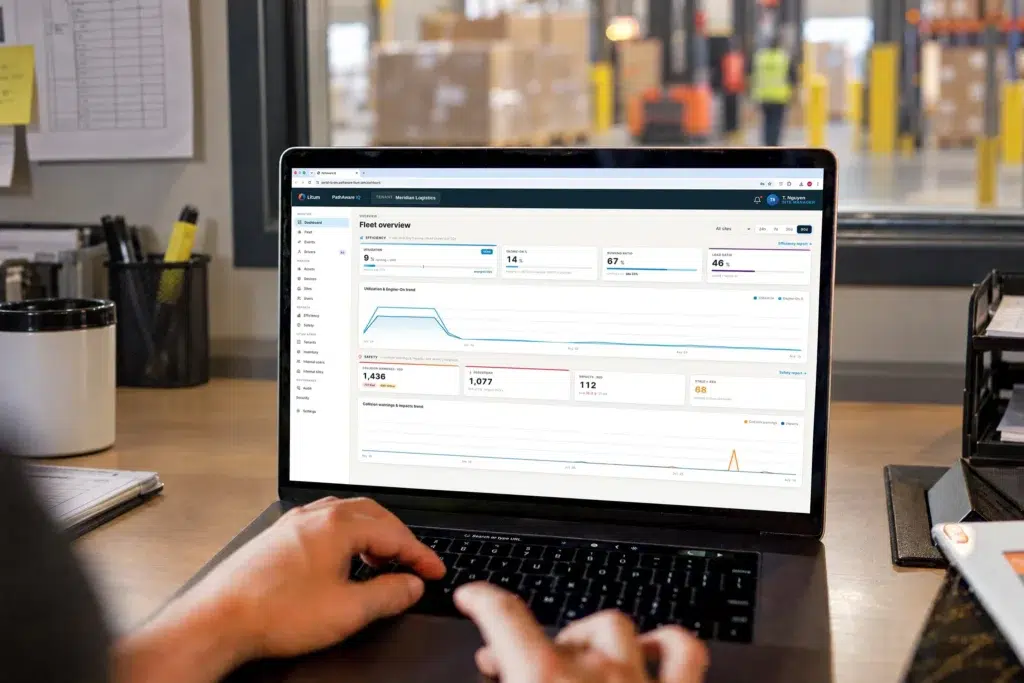
Systems that record those events give a safety team something to work with. When each alert is logged with the vehicle, the operator, the area and the shift, patterns begin to show:
- The same intersection generating warnings on the afternoon shift
- One aisle where reversing events cluster
- An operator whose alerts fall after a refresher course
A record like that shows whether the site is actually getting safer, not only that the system is issuing warnings.
Records Beyond Collisions
Safety managers are regularly asked three other questions:
- Who was operating the truck?
- Was its pre-operation inspection completed?
- How heavily is each vehicle used?
Audits raise the first two, and lease renewals and fleet purchases raise the third. A system that already holds those records answers them from data rather than from paper logs and memory.
When comparing systems, it helps to ask what the data will be able to answer six months after installation, alongside how the alert performs on the first day.
How PathAware® Approaches It
PathAware® starts on the vehicle rather than the facility. Detection runs on the forklift itself, using AI-enhanced sensing to pick up pedestrians, other vehicles and objects, forward and in reverse, and in dust, darkness and glare. UWB adds vehicle-to-vehicle awareness.
- No cameras, no facility-wide RTLS and no mandatory wearables
- Retrofits across forklift brands and models, leased or owned
- Deploys truck by truck, starting where risk is highest
Pedestrian detection is tagless by default. The system detects motion without identifying individuals, with no facial recognition or image storage, so workers have nothing to wear and the site has no footage to govern. Compared with computer vision, the approach is up to 80% more cost-efficient.
PathAware® comes in three tiers, each building on the one below.
PathAware® Core
PathAware® Core provides plug-and-play proximity detection and in-cab alerts that help reduce collision risk from the first day. It is built for operations that want to reduce immediate collision risk without adding infrastructure, with configurable audiovisual warnings that tell the operator when a pedestrian, vehicle or object comes too close.
PathAware® IQ
PathAware® IQ adds a connected software layer for safety visibility, accountability and control. Safety events are captured across the fleet and turned into dashboards that show where, when and how risk occurs, so safety teams can see:
- Recurring collision patterns, compared across vehicles, areas and shifts
- Operators or areas that need additional attention
- Whether corrective actions are reducing risk over time
PathAware® IQ also adds operator identification and access control. Operators identify themselves with an NFC card or a compatible Litum tag, and vehicle access can be limited to authorized operators.
PathAware® IQ+
PathAware® IQ+ adds inspection workflows and utilization insights, connecting what happens around the forklift to how the fleet is used.
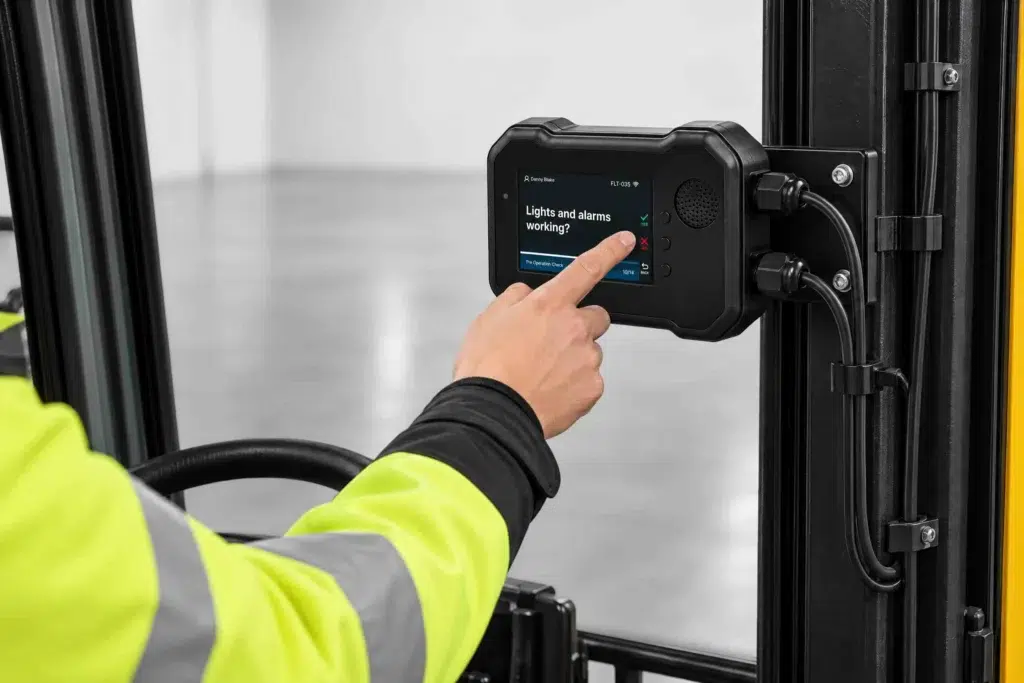
Digital pre-operation inspections. The checklist moves from paper to the vehicle, where it is completed before operation.
- Completion can be enforced
- Defects can be reported immediately, with supervisors notified
- Records are retained for follow-up and audits
Utilization insights. PathAware® IQ+ captures how each forklift is actually used.
- Active time, idle time and engine-on time
- Load ratio, the share of operating time spent carrying a load
- Usage patterns over time
Together, these show which forklifts are heavily used, which sit idle and which may be candidates for reallocation. That supports better decisions before renewing leases or purchasing additional equipment.
Add-Ons on Any Tier
- SlowDown automatically reduces vehicle speed when defined risks are detected or when a forklift enters a configured safety area.
- ZoneLite sets safety zones for intersections, pedestrian crossings and restricted areas without a full RTLS deployment.
Sites that later need a facility-wide view can extend into Litum’s RTLS platform for vehicle location, traffic analysis and congestion visibility.
Choosing for the Site You Run
A forklift safety system is chosen once and lived with for years. The one that fits the building, the fleet and the workforce as they are today, and keeps records the site will still be using later, is the one most likely to stay in use.
Learn more about PathAware®, or contact us to talk through how it would work at your site.