



There is no requirement to deploy RTLS everywhere at once. In fact, the strongest deployments rarely start that way.
The stronger starting point is not a technology decision at all. It is a business decision: what are we unable to see today that is costing us something? Once that question has an answer, the technology choice, the pilot scope, and the path to scale all become easier to reason about.
Start with something worth solving
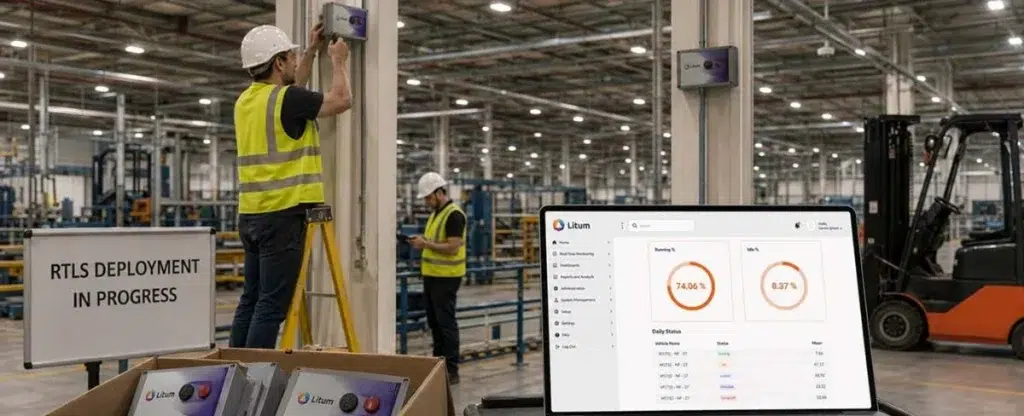
A good first RTLS project is often deliberately narrow. Rather than trying to cover an entire site, it makes sense to pick one troublesome group of assets, one production process, one forklift risk area, one contractor workforce, one mustering problem, or one yard.
The first deployment should answer two questions: did the technology work in the real environment, and did the resulting information improve the chosen outcome. If the answer to both is yes, expansion becomes easier to justify.
Accuracy should follow the use case
Knowing whether a container is in Yard A or Yard B may require very different technology from detecting a high-risk interaction between a forklift and a pedestrian. Forcing every use case onto the same technology merely because it is already installed tends to produce worse outcomes than matching accuracy to the decision each use case actually requires.
That is a technology selection question in its own right, and we cover the tradeoffs between UWB, BLE, GPS, LoRaWAN, and RFID in more detail in our guide to choosing the right RTLS technology. What matters for a rollout plan is simpler: one architecture can still support several positioning technologies at once, as long as the software and integration layer is designed for it.
The economics change when infrastructure can be reused
If every new use case brings another server, another integration, another set of gateways, another device-management tool, and another support relationship, the operational cost of location technology can grow quickly.
Shared infrastructure does not mean identical hardware everywhere. It means reusing software, integrations, infrastructure, and data where doing so makes technical and operational sense. This is the real economic argument for starting narrow but planning for scale from day one: a well-scoped pilot on reusable infrastructure becomes the foundation for the next deployment instead of a one-off project that gets rebuilt from scratch.
RTLS should not become another data island

Location data is most useful when it can reach the systems where work is already being managed. An asset’s physical position may need to be reconciled with SAP. A process event may need to update an MES. Vehicle data may belong in fleet-management software. Workforce information may connect to HR. Operational analytics may ultimately belong in Tableau or Power BI.
Modern industrial RTLS therefore needs APIs and integration capabilities alongside positioning. Security and governance belong in the architecture from the start, not as an afterthought: role-based access, authentication, data retention, privacy controls, encryption, availability, and audit records should all be evaluated before large volumes of location data are collected, not after.
What to evaluate before scaling a vendor relationship
A specification sheet can tell you a great deal about a tag. It tells you less about whether the system will become useful infrastructure as it scales. A few questions are worth asking before committing to a rollout beyond the pilot stage:
- Can later applications build on the hardware, software, and integrations already deployed, or does each new use case start over?
- Can the platform interpret dwell, proximity, entry, exit, inactivity, and escalation as business rules, not just display a live map?
- Does supporting thousands of devices across multiple sites look meaningfully different from supporting fifty devices in a pilot?
- When hardware, firmware, positioning, software, integration, and deployment intersect, who owns the problem?
We go deeper into vendor evaluation criteria in what to consider when choosing an RTLS partner. One valid model is end-to-end ownership, where a single vendor designs the hardware, firmware, location engine, applications, and analytics as a connected system while supporting integration and deployment across many sites. That is not the only valid model. Whatever model is chosen, responsibility should be clear before the project scales, not after something breaks.
A practical sequence
- Identify the visibility gap. Where are you losing safety, time, utilization, or throughput?
- Establish the baseline. Quantify the current state before selecting a system.
- Define the decision. What will someone do differently once the location data exists?
- Match accuracy to the use case. Choose the technology after the operational requirement is clear, not before.
- Prove the result. Measure the same KPI after deployment that you measured before it.
- Scale deliberately. Reuse infrastructure and integrations where the economics and architecture make sense.
The technology matters. The location matters. But the business question comes first, and it stays first at every stage of the rollout, not only at the pilot.
FAQ
What is a phased rollout for RTLS? A phased rollout starts with one narrow, well-defined use case, such as one asset group, one process, or one work area, proves that it delivers measurable value, and then expands to additional use cases using infrastructure and integrations already in place rather than rebuilding from scratch each time.
How do you avoid RTLS becoming a data island? By requiring APIs and integration capabilities from the start, so location data can flow into the systems already managing the operation, such as ERP, WMS, MES, fleet management, HR, and BI tools, rather than living in a standalone dashboard disconnected from the rest of the business.
Does every RTLS use case need the same technology? No. Different use cases often need different positioning technology. A single architecture can support UWB, BLE, GPS, LoRaWAN, and RFID at the same time, matching accuracy to what each specific decision requires rather than forcing every application onto whichever technology was deployed first.
What should be evaluated before scaling RTLS beyond a pilot? Infrastructure reuse, how the platform interprets business rules like dwell and proximity, systems integration with ERP and other operational software, security and governance controls, and clear accountability for who owns the problem when hardware, software, and integration intersect.