

This article was originally published on LinkedIn by Burak Menekse, VP of Engineering at Litum, on October 19, 2026.
A site that went a full quarter without a forklift collision may be a safe site. It may also be a fortunate one. Looking at the incident log alone, there is no way to tell which.
Much of my work leading engineering comes down to two questions: what are we measuring, and what are we measuring it against? In forklift safety, the first question usually has a clear answer. The second one often does not.
A collision count needs something to be counted against
Two collisions in a quarter mean one thing for a site running five forklifts on a single shift. They mean something else for a site running sixty forklifts around the clock. The number is the same. The risk behind it is not.
Most safety reporting starts and ends with the numerator: collisions, injuries, damaged racking, the events that make it onto a form. What is usually missing is the denominator, the measure of exposure that gives those events their meaning. For forklifts, exposure includes:
- How often forklifts and pedestrians come close enough that one of them has to react
- How often vehicles come close to each other, and whether it happens moving forward or in reverse
- How many hours each forklift actually runs, and how much of that time it carries a load
- Who is operating, and on which shift
Without that, a safety team can report what happened. It is much harder to say how likely it was to happen, or whether it is becoming more or less likely.
Collisions are too rare to steer by: why near misses lead

Low collision numbers are part of the measurement problem. When an event happens a handful of times a year, a single quarter says very little. One collision more or less moves the trend line, and nobody can tell whether that movement means anything.
In safety terms, collisions and injuries are lagging indicators. They confirm risk after it has already turned into harm. Near misses and exposure are leading indicators, because they show where risk is building while there is still time to reduce it.
Near misses happen far more often, and that is what makes them useful. They give a safety team enough events to see a pattern before a collision forces the decision.
The difficulty is that near misses have traditionally depended on someone choosing to report them. An operator has to stop, recall the moment clearly and fill in a near-miss report about a close call they were part of. In the middle of a busy shift, that rarely happens consistently. The resulting log says a great deal about a site’s reporting culture and much less about its actual exposure.
Near-miss data is only as good as the alert behind it
From the engineering side, one point comes up again and again. When a safety system records events automatically, the quality of that record depends on the quality of the alert that produced it.
If a system warns too often, operators learn to tune it out, and the event log fills with noise that no one trusts. If it misses real hazards, people stop relying on it. Either way, every report built on that data inherits the problem.
This makes alert design a data quality question as much as an operator experience question. Warnings need to be configurable to how a site actually operates, clear about whether the hazard is ahead or behind, and aware of conditions such as a load on the forks that call for more caution. An operator who trusts the warning responds to it, and a system operators respond to produces events worth counting.
What changes when exposure is measured

Once close calls are captured as they happen, the questions a safety team can answer begin to change:
- Whether one shift accounts for more pedestrian near misses than its operating hours would explain
- Whether a particular vehicle generates more warnings in reverse than the rest of the fleet
- Whether a newly authorized operator’s warnings settle over their first weeks on the truck
Whether a site that changed its pedestrian traffic rules last month is now seeing fewer close calls
The last question matters most to me. A safety action without a measurement afterwards is a hope. With exposure data, a team can make a change, wait a few weeks and see whether the risk it targeted actually moved.
Operating time belongs in that picture too. A forklift that triggers twice as many warnings as the one beside it may simply be running twice as many hours. Safety events become comparable only once they sit next to how much each vehicle actually worked.
How we approached this with PathAware®
This thinking shaped how we built PathAware®, Litum’s connected forklift safety and telematics product.
PathAware® Core is the foundation. It detects pedestrians, vehicles and objects around the forklift and warns the operator in the cab, without cameras or mandatory wearables. For many sites it does an important job on its own: putting a clear warning in front of the operator at the moment it is needed. Each of those warnings is also a moment worth counting.
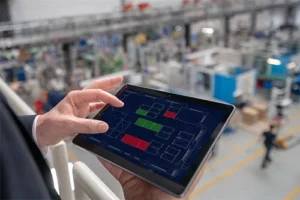
PathAware® IQ is where that counting begins. Every warning is recorded with its time, length, vehicle and operator, then turned into safety reports and dashboards that show when and how risk occurs across vehicles, operators and shifts. Because operators identify themselves before driving, each event carries the context needed to act on it, from targeted training to a closer look at a specific vehicle. Safety teams can see whether exposure is rising or falling over the period they choose, and compare sites side by side.
PathAware® IQ+ builds on IQ by adding operating context to the record. Pre-operation inspections are completed and logged at the vehicle, and utilization data such as active time, idle time and load ratio sits beside the safety events. That makes it possible to read each forklift’s safety record against how much it actually worked and the condition it started the shift in.
Because PathAware® is a retrofit system that works across forklift brands and models, leased or owned, the same measurement applies to every vehicle on the floor. On a mixed fleet, that consistency is what makes one forklift’s record comparable with the next.
Counting what almost happened
On every site that runs forklifts, each shift has moments that end well: a driver who brakes before a blind corner, a pedestrian who steps back from a reversing truck. Most of those moments leave no trace. The shift ends, the log stays clean, and the site learns nothing from them.
Measuring exposure is a way of keeping those moments. Each one says something about where risk builds and how the team responds to it. Taken together, they give a safety manager what an incident log cannot: a fair account of how close the site comes, and whether that distance is growing or shrinking.
That account still depends on people. Supervisors decide what to do with it, and operators make the split-second choices that turn a close call into a moment that ends well. What measurement gives them is proof that those moments happened, and evidence of which efforts are working.
Every safety team relies on some number to tell them how they are doing. Which number do you trust most when judging forklift safety, and what does it leave out?
PathAware® is Litum’s forklift safety and telematics product, running on the vehicle rather than the building, with collision awareness, operator control, digital inspections and utilization insights across three tiers.
Follow Litum for more on forklift safety and industrial operations.