



Worker Tracking is a crucial part in EPC. Engineering, procurement, and construction (EPC) projects operate at a scale where conventional safety and workforce management approaches quickly reach their limits. When a site spans more than a square kilometer, employs tens of thousands of workers and subcontractors, and involves constant movement across complex hazardous zones, visibility gaps translate directly into accidents, payroll errors, and compliance failures.
This case study examines how a leading global EPC provider deployed Litum’s Connected Worker RTLS to address these challenges. By combining UWB workforce tracking with HR integration and safety monitoring, the organization achieved $2.8 million in annual cost savings.
The Challenge: 10,000+ Workers Across a Complex Fabrication Yard

The client’s fabrication yard combined several challenges typical of large EPC and construction RTLS environments. More than 10,000 employees and subcontractors worked across a site spanning over 1 square kilometer, with a steel-intensive layout and harsh environmental conditions that made static safety systems inadequate. A large and diverse workforce created complex HR, payroll, and safety and compliance requirements. High-risk zones, fall hazards, and restricted areas required active monitoring to prevent workplace incidents and accidents rather than reactive response after events had occurred.
The Solution: UWB Worker Tracking RTLS for EPC Workforce Safety

Litum’s comprehensive workforce safety and efficiency solution employed Ultra-Wideband (UWB) technology for pinpoint accuracy in real-time location tracking. The system was integrated with the client’s HR systems, streamlining timekeeping, payroll, and safety compliance. The deployment included monitoring and alert systems addressing free-fall incidents and unauthorized access to hazardous zones. A business rule engine and workforce management dashboard enabled actionable insights through detailed analytics.
The initial setup spanned over 22 designated zones, equipping 5,500 assets and employees with tags. The system was designed to adapt continuously to the dynamic conditions of the site.
Key Features of the Workforce Safety and Efficiency RTLS
Automated Time and Attendance RTLS
Automated time and attendance RTLS streamlined logging of employee hours directly into the system, replacing manual processes across a large distributed workforce. This location data fed directly into payroll systems, automating calculation of wages based on accurate work time data and eliminating discrepancies between recorded and actual hours worked.
Employee Safety Monitoring and Emergency Response
Safety monitoring addressed the specific risk profile of the fabrication yard. The system included emergency response buttons for instant alerts with precise worker location, fall detection to identify free-fall incidents automatically, and immobility detection to flag workers who have stopped moving unexpectedly. Together these features closed the gap between when a workplace accident occurs and when emergency response reaches the right location, reducing the time cost of incidents and preventing accidents from escalating.
Workforce Monitoring, Geofencing, and Analytics
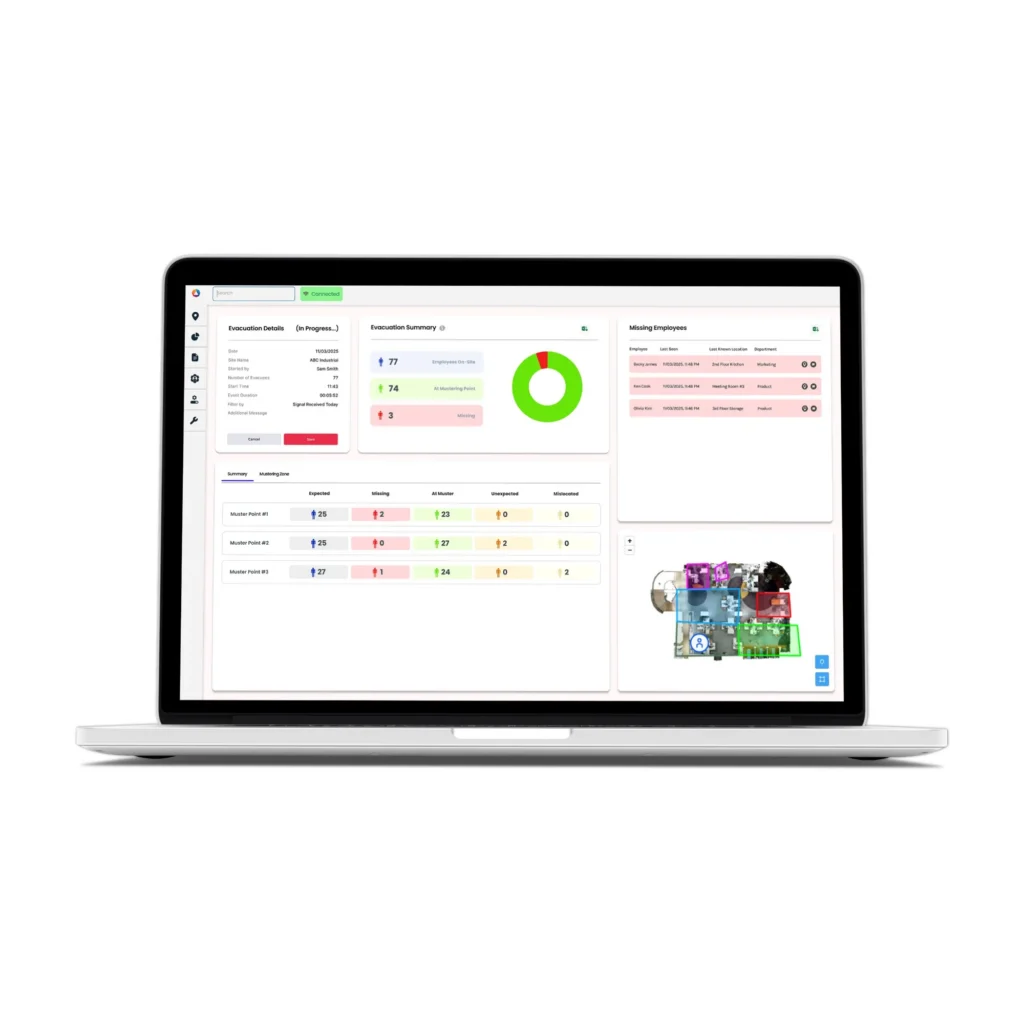
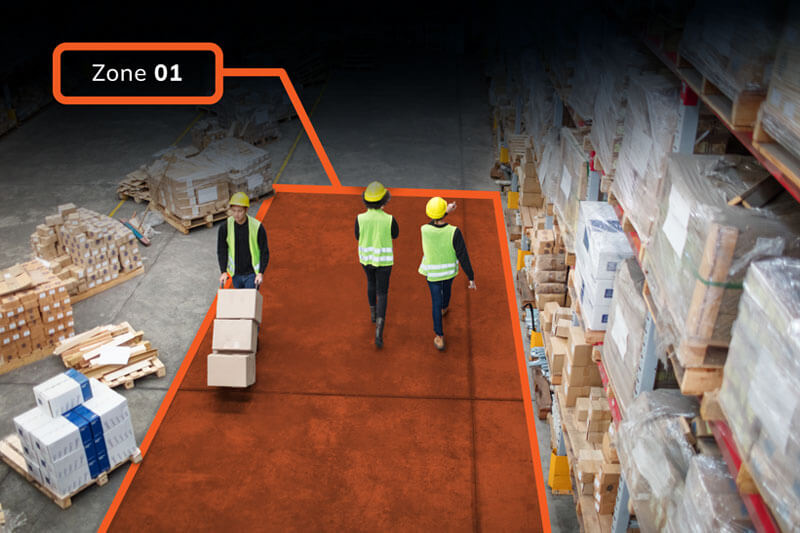
Real-time tracking of employee locations and assignments gave site managers a live view of worker and subcontractor positions across all 22 zones. Geofencing around hazardous areas generated time alerts when workers entered restricted zones without authorization, supporting compliance with safety regulations. The analytics layer transformed continuous location data into workforce productivity insights: zone occupancy, task completion patterns, and resource allocation, enabling managers to optimize workflows and identify inefficiencies across the site.
The Results: $2.8M in Annual Cost Savings
$2.8M Annual cost savings from the RTLS deployment
The implementation of Litum’s RTLS solution significantly boosted operational efficiency and employee safety standards at the site. Improvements in process accuracy and compliance with safety protocols led to a notable reduction in operational errors. Financially, these enhancements translated into annual cost savings of approximately $2.8 million, underscoring a substantial return on investment and enhanced operational productivity.
Why EPC and Construction Sites Benefit from Worker Tracking RTLS
Large EPC and construction site worker tracking deployments address the unique combination of scale, workforce diversity, dynamic conditions, and safety exposure that makes construction site worker tracking making construction consistently one of the highest-risk sectors for workplace accidents and incidents. A connected worker solution does more than track employee locations. It creates an integrated safety layer covering duress alerting, fall detection, zone-based access control, and emergency mustering using the same RTLS infrastructure.
Lone workers operating in isolated areas of large construction sites are among the most vulnerable personnel on any EPC project. Lone worker protection using RTLS monitors lone workers continuously, with automatic alerts if they stop moving, enter a hazardous area, or fail to respond. The same platform that handles employee safety also supports asset tracking for tools, equipment, and vehicles, giving construction site worker tracking a comprehensive view of both personnel and assets. As enterprise asset tracking has evolved, organizations increasingly deploy unified platforms that serve both safety and operational efficiency use cases simultaneously.
Applications: Construction Site Worker Tracking, Manufacturing, and Beyond
Frequently Asked Questions
How does employee location tracking improve workplace safety?
Employee location tracking gives safety teams real-time visibility into where every worker is at any time. Combined with automatic fall detection, immobility alerts, and emergency response buttons, it closes the gap between when a workplace accident occurs and when help reaches the right location. In the EPC case study, this approach was central to the measurable improvement in safety and compliance outcomes.
How accurate is employee location tracking?
Accuracy depends on the technology. UWB workforce tracking technology, used in this EPC deployment, delivers sub-meter location accuracy in complex industrial layouts, identifying exactly which zone or area a worker is in. For applications where zone-level awareness is sufficient, Bluetooth (BLE) provides a lower-cost alternative. Litum’s Connected Worker RTLS supports both, matching location accuracy to the requirements of each use case.
Can the same RTLS be used to track assets on the shop floor?
Yes. The same RTLS infrastructure used for worker tracking simultaneously monitors equipment, tools, and mobile assets. In the EPC case study, 5,500 tags covered both employees and assets. Litum’s asset tracking capabilities run on the same platform as worker safety features, giving organizations a unified view of personnel and assets without separate systems.
Can employee tracking data be shown in real-time dashboards?
Yes. Location data is displayed in a real-time workforce management dashboard showing live worker positions, zone occupancy, safety alert status, and time location data analytics. In the EPC deployment, the dashboard enabled site managers to make informed decisions based on continuous location data. Dashboards can be configured by role, from safety officers to project managers.
What is a connected worker solution?
A connected worker solution links field workers to safety and operational infrastructure using wearable RTLS technology. Workers wear tags that broadcast their location, enabling duress alerting, fall detection, zone monitoring, automated time and attendance RTLS, and emergency response. Litum’s Connected Worker platform covers all these capabilities for industrial environments, from fabrication yards to manufacturing facilities.
How does RTLS protect lone workers?
RTLS monitors lone workers continuously. If a lone worker stops moving unexpectedly, enters a hazardous zone, or fails to respond, the system generates an automatic alert without requiring the worker to take any action. Litum’s lone worker safety RTLS is designed for high-risk industrial and construction sites where lone workers operate without direct supervision, protecting against accidents that would otherwise go undetected.
What is the difference between connected worker and employee tracking?
Employee tracking monitors worker location and activity. Connected worker is a broader concept covering safety integration: duress alerting, lone worker protection, automated time and attendance RTLS, emergency mustering through RTLS mustering, safety compliance monitoring, and analytics. The EPC case study demonstrates the full scope of what a connected worker RTLS platform delivers when deployed at scale across 10,000+ workers.
What This EPC Case Study Demonstrates
The $2.8 million in annual savings reflects compounding gains across payroll accuracy, operational efficiency, accident prevention, and safety compliance. Each improvement came from the same underlying capability: real-time visibility into where workers and assets were, with automated responses when conditions fell outside defined parameters.
For EPC providers, construction companies, and large industrial operators, this case study offers a concrete example of what RTLS technology delivers at scale. To learn more about Litum’s Connected Worker RTLS and workforce safety solutions, visit litum.com.