
Forklift and Pedestrian Safety At a Glance
Client: Fortune 500 automotive manufacturer
Location: Mexico
Facility Size: 500,000 square feet
Technology: UWB RTLS, automated route optimization, collision warning, data analytics
Operational Efficiency Improvement: 35 to 55%
Safety Outcome: Substantial reduction in incidents
In automotive manufacturing, forklift operations are a critical and constant part of the production floor. When a forklift fleet is not tracked, optimized, or monitored for safety, inefficiencies accumulate quickly and the risk of accidents rises. For a Fortune 500 automotive manufacturer operating a 500,000 square foot section of their Mexican plant, these challenges had become significant enough to require a purpose-built technology solution.
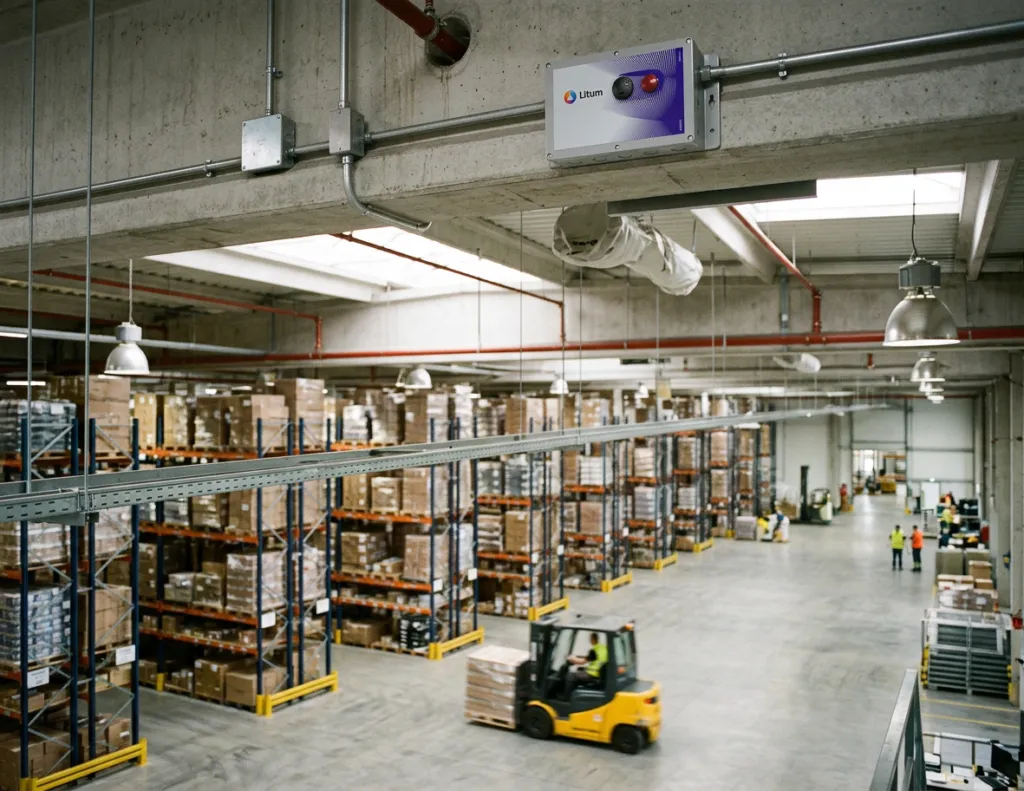
Litum deployed a comprehensive RTLS forklift tracking solution using Ultra-Wideband (UWB) technology to address both the efficiency and forklift pedestrian safety dimensions simultaneously.

Key Challenge
A Fortune 500 automotive manufacturer faced operational inefficiencies with its extensive fleet of forklifts within a 500,000 square foot section of their Mexican plant. The challenge was to enhance asset management, optimize routing, and reduce operational costs while maintaining a high standard of safety and compliance within a fast-paced and strictly scheduled environment, which posed significant risks for accidents and inefficiencies.
Forklift pedestrian safety is one of the most serious hazards in any manufacturing or warehouse environment. According to NIOSH, forklifts cause dozens of fatalities each year in the US alone. Approximately 36% of forklift-related fatalities involve pedestrians, and the National Safety Council reports nearly 100,000 forklift-related injuries occur annually. In a 500,000 square foot facility with heavy forklift traffic and pedestrian workers sharing the same floor space, the risk to both forklift operators and pedestrians is significant without an automated safety system in place.
OSHA 29 CFR 1910.176(a) requires that safe clearances be maintained for aisles and pedestrian walkways in industrial workplaces. Manual enforcement of these requirements across a large facility with active forklift traffic is inconsistent and difficult to audit. OSHA fines for non-compliance add financial risk on top of the direct safety risks to workers.
Solution
Litum deployed a comprehensive RTLS solution to address these challenges. By integrating Ultra-Wideband (UWB) technology, the system ensured accurate routing and efficient utilization of forklifts. The solution featured an automated route optimization function that utilized historical and real-time movement data to dynamically adjust forklift paths to minimize travel times and prevent bottlenecks. The RTLS solution also offered extensive data analytics capabilities, providing detailed reports on vital metrics.
How the System Worked
Each forklift in the fleet was equipped with a UWB RTLS tag. Fixed anchors installed throughout the facility tracked the precise location of every forklift in real time, feeding data into Litum’s software platform. The platform applied route optimization algorithms using both historical movement patterns and live positional data to dynamically adjust forklift paths as conditions on the floor changed.
Supervisors and operations managers accessed live dashboards showing fleet positions, load status, idle time, and safety alert history. This gave the team the visibility to make immediate operational adjustments and the data to support longer-term process improvements.
Features Deployed
• Real-Time Tracking: Continuously monitors forklift locations, enhancing operational adjustments and forklift visibility
• Automated Route Optimization: Uses real-time and historical data to dynamically optimize forklift paths, reducing travel times and improving efficiency
• Safety and Collision Alerts: Issues proactive forklift pedestrian safety warnings when forklifts approach workers or pedestrian walkways, significantly reducing collision risk
• Idle Time Monitoring: Identifies and analyzes idle periods to reduce unnecessary energy consumption and improve efficiency
• Load Status Identification: Monitors whether forklifts are loaded or unloaded, aiding in task prioritization and load balancing
• Customizable Operational Dashboards: Features adaptable dashboards that provide essential metrics and insights for informed decision-making
• Data Analytics and Reports: Offers detailed reports on efficiency, safety, and asset utilization to support ongoing improvements
Results
35-55% improvement in operational efficiency
Litum’s deployment resulted in a significant boost in forklift utilization, with the client’s operational efficiency improving by 35 to 55%. The solution also significantly improved safety within the facility, leading to a substantial reduction in incidents and fostering a safer working environment.
The automated route optimization reduced travel times and eliminated the bottlenecks that had previously disrupted production schedules. Idle time monitoring gave management visibility into underutilized assets, enabling better fleet allocation. Collision alerts reduced the risk of forklift-pedestrian and forklift-forklift incidents without requiring additional safety personnel on the floor.
Why Forklift Pedestrian Safety Requires an Automated Approach
Automotive manufacturing is one of the most demanding environments for forklift fleet management. Production runs on tight schedules, parts delivery windows are measured in minutes, and the volume of forklift movements across a large facility is constant. Without real-time visibility, inefficiencies are invisible until they appear as production delays or safety incidents.
RTLS changes this by making every forklift movement visible, measurable, and optimizable. Route optimization reduces unnecessary travel. Idle time monitoring eliminates waste. Collision alerts reduce incident risk without adding headcount. And the data analytics layer gives operations leaders the information they need to make continuous improvements, not just respond to problems after they occur.
For a 500,000 square foot facility with an extensive forklift fleet, a 35 to 55% improvement in operational efficiency represents a significant reduction in production costs and a measurable improvement in throughput. Learn more about Litum’s forklift tracking solution and forklift collision warning system.
Frequently Asked Questions
Are pedestrians safe around forklifts?
Pedestrian safety around forklifts depends entirely on the controls in place. Without designated pedestrian walkways, clear right-of-way rules, and active monitoring, the risks are significant. OSHA’s pedestrian safety guidelines require facilities to establish and enforce separation between forklift traffic and pedestrian traffic. RTLS collision warning systems add an automated layer of protection by alerting forklift operators and pedestrians in real time when they approach each other, reducing reliance on manual safety training and line-of-sight awareness.
What are 5 safety rules for a forklift?
Key forklift safety rules under OSHA 1910.178(n)(4) and general occupational safety practices include: (1) always yield to pedestrians and maintain right of way in pedestrian zones; (2) travel at safe speeds appropriate for the facility and pedestrian traffic conditions; (3) never exceed load capacity; (4) keep forks lowered when traveling; (5) sound the horn at intersections and blind spots. In high-traffic facilities, RTLS supplements these rules with automated alerts when forklift operators and pedestrian workers are in proximity.
What are five safety guidelines for pedestrians working near forklifts?
Pedestrian workers sharing space with forklifts should: (1) stay within marked pedestrian walkways at all times; (2) make eye contact with forklift operators before crossing forklift traffic lanes; (3) never assume a forklift operator can see them; (4) avoid distractions such as mobile phones in active forklift zones; (5) follow all safety training and awareness procedures specific to their facility. Automated systems like RTLS proximity alerts provide an additional safety layer that does not depend on pedestrian behavior alone.
What is the 3-foot rule for forklifts?
The 3-foot rule is a general industry guideline stating that forklifts should maintain at least a 3-foot clearance from pedestrian workers and obstacles when operating in shared spaces. Some facilities apply wider clearances depending on forklift speed and load size. OSHA standards require adequate clearances in aisles and walkways, and RTLS proximity warning systems can be configured to trigger alerts at any defined distance threshold, enforcing safe clearance zones automatically across the entire facility.
See how Litum’s RTLS can improve forklift pedestrian safety and efficiency in your facility. Explore Litum’s forklift tracking solution and see all industrial case studies at litum.com/industrial-case-studies/.