



Table of Contents
In the ever-changing landscape of wireless communication, Ultra-Wideband (UWB) technology has emerged as a significant advancement. Imagine a technology that is super precise, fast, and reliable. That’s what UWB tracking is bringing to the table, setting the stage for a transformation in real-time location systems (RTLS).
Across industries, UWB asset tracking is becoming the default answer to a simple operational question: where is it right now? This guide unpacks how ultra-wideband technology works, how UWB compares with RFID and other technologies, and where UWB tracking is headed next.
A Quick Introduction to Ultra-Wideband Technology
Simply put, UWB is a short-range pulse radio technology that can pinpoint the location of people, devices, and assets with high accuracy. Unlike Bluetooth and Wi-Fi, which use continuous signals, UWB sends out short, nanosecond pulses across a broad range of frequencies to transmit data between devices.
In practice, this means UWB-enabled devices can quickly send data over short distances and maintain a clear, real-time picture of where other devices are located. As a communication technology built on impulse radio principles, UWB was originally developed for military radar before moving into commercial indoor positioning.
Understanding UWB Positioning and RTLS
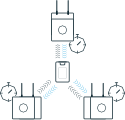
UWB positioning uses a technique known as time difference of arrival (TDoA). Multiple receivers measure when a UWB signal from a tag arrives, and the small differences in arrival time reveal the tag’s position.
TDoA works because radio signals travel at a constant speed, the speed of light. When a tag emits a signal, several anchors receive it at slightly different times. Those differences, based on each anchor’s distance from the tag, let the system calculate position.
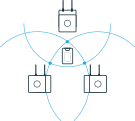
UWB positioning also uses two-way ranging (TWR) as an alternative to TDoA, exchanging signals directly between a tag and anchor to measure distance. The system uses trilateration, requiring at least three receivers to calculate a target’s exact position, often achieving indoor positioning accuracy within a few centimeters. For a broader technical overview, see our guide on indoor positioning systems.
This is what makes UWB the backbone of modern UWB RTLS deployments. The location engine, a software layer, combines the raw ranging data from every anchor and tag into a live map of positions, feeding precise location tracking data into dashboards, alerts, and downstream systems in real time.

How UWB Asset Tracking Works
UWB asset tracking follows the same underlying positioning principles applied specifically to physical assets. Each UWB tag attached to equipment, inventory, or a vehicle continuously exchanges signals with fixed anchors installed across a facility. The location engine converts those signals into position tracking data, updating an asset’s location on a live map every few seconds. Because UWB RTLS tags support both TDoA and TWR positioning, the same infrastructure can support high-density warehouses and smaller, high-accuracy zones like operating rooms within a single deployment.
Advantages of UWB Technology
UWB technology distinguishes itself in the realm of positioning technologies through a suite of unique advantages that it offers. This analysis outlines the salient features of ultra-wideband technology, asserting its efficacy in various real-world applications.
Precision in Indoor Positioning
A fundamental advantage of UWB technology lies in its high accuracy in indoor positioning. With positioning accuracy within the range of a few centimeters, UWB can measure distances between devices effectively. By utilizing beacons or anchor nodes to transmit real-time location information, it provides accurate tracking of people or assets within enclosed indoor environments such as factories or warehouses.
Consequently, UWB technology can significantly enhance operational efficiency through improved inventory management and optimized equipment utilization. This level accuracy is difficult to replicate with other tracking technologies that rely on signal strength rather than time-of-flight measurements.
Robust Security in Communication
UWB technology provides a high degree of security due to the characteristics of its signal. It operates at very high frequencies and uses low-power, short-duration pulses, making it difficult for traditional receivers to detect or jam, even with the most advanced interference techniques.
UWB technology employs a Time of Flight (ToF) mechanism that sends ultra-short pulses to measure the time taken for these UWB pulses to reach the receiver. This allows for precise and reliable distance measurements. However, as with any wireless communication technology, the data transmitted within these pulses needs to be encrypted to ensure security. Due to these features, UWB has gained traction in industries that prioritize secure and precise communication, including military radar systems and government sectors.
High Data Rates
UWB technology stands out for its high data transmission rates on par with USB 2.0. This speed is achieved as UWB utilizes pulses that last just a few nanoseconds, ensuring swift data transfer rates. As such, UWB is suitable for applications demanding high data transfer rates, including high-resolution video streaming and virtual reality, among others.
Low Power Consumption
Designed for efficiency, UWB technology is notable for its low power consumption. UWB-enabled devices can activate ultra-low energy modes, thereby prolonging battery life in embedded applications. Due to the brevity of the pulses utilized, UWB requires minimal power to function.
Compared to continuous-connection wireless technologies like Bluetooth, UWB devices communicate intermittently, further conserving battery life.
Enhanced Accuracy in Range Detection
UWB technology boasts high accuracy in location and proximity detection, even in cluttered environments. This UWB accuracy, often within a few centimeters, renders it suitable for applications such as automated doors, smart homes, and vehicle systems, among others.
A device equipped with UWB technology can detect other UWB devices or obstacles within its UWB range. That range depends on hardware and environmental conditions, and can exceed ten meters in open indoor environments. This makes UWB an invaluable tool not just for proximity detection systems, but also secure communications and radar systems.
The Rising Prominence of UWB Technology Across Industries
Increasing Industry Adoption
Prominent consumer electronics manufacturers, such as Apple, Samsung, and Google, have integrated UWB technology into their devices. For instance, Apple’s iPhone 11 houses the U1 ultra-wideband chip, showcasing the expanding incorporation of UWB in smartphones.
Beyond consumer electronics, UWB finds applications in unique sectors. The National Football League (NFL) utilizes UWB chips embedded in players’ shoulder pads to track real-time location and movement during games, providing granular performance analysis.
Automotive companies are increasingly exploring UWB applications to enhance user experiences such as secure, convenient access control.
Moreover, UWB hardware vendors and consortiums like the UWB Alliance and FIRA contribute to the technological development and standardization of UWB, offering diverse UWB components suitable for specific use cases.
Convergence with Emerging Technologies
Another significant trend is the convergence of UWB tracking with other emerging technologies. For instance, the integration of UWB with Augmented Reality (AR) has augmented immersive experiences, accurately superimposing virtual information onto real-world environments. Additionally, pairing UWB tracking with Internet of Things (IoT) devices has facilitated the creation of intelligent, adaptable systems and smart environments.
This convergence depends on seamless integration between UWB hardware, positioning software, and the platforms organizations already use, from ERP systems to security software.
UWB vs. RFID and Other Technologies
While UWB offers numerous benefits, a comparison with other tracking technologies provides a more comprehensive understanding of its value proposition. Unlike infrared and ultrasound sensors, UWB-based indoor localization does not require line-of-sight and remains unaffected by communication devices or external noise, owing to its wide frequency band and signal modulation.
Compared to Bluetooth Low Energy (BLE) and Wi-Fi, UWB technology exhibits marked advantages. Obstacles and signal interference that may impact BLE and Wi-Fi signals have a negligible effect on UWB devices, allowing precise trilateration and enhanced positioning accuracy.
UWB vs. RFID
RFID (Radio Frequency Identification) and UWB are often confused, but they solve different problems. RFID systems identify what an object is: a reader detects a tag’s unique ID as it passes within range, which is why RFID excels at checkpoint-based inventory counts and access control. UWB tells you where an object is, continuously, with centimeter-level accuracy, rather than only at a fixed checkpoint.
Many facilities combine RFID and UWB in a single deployment, using RFID for high-speed identification at doorways and UWB for precise position tracking once an asset is inside. See our detailed comparison of RTLS and RFID for a full breakdown of when each technology fits best.
Additionally, the requirement for expensive equipment is reduced with UWB, rendering it a cost-effective solution for indoor positioning and precise location tracking data acquisition.
The growing market for indoor positioning technology has found a reliable ally in UWB technology, and its role in powering real-world applications in industries such as healthcare, retail, and transportation is undeniably significant.

The Future Outlook and Emerging Trends in UWB Technology
UWB technology holds a promising future as its adoption accelerates across various industries. Many experts believe that it might eventually equal or surpass Bluetooth and Wi-Fi, positioning itself as the preferred technology for short-range communication and localization.
Emerging Trends in UWB Positioning Systems
As UWB tracking continues to evolve, several emerging trends are shaping its future. One such trend is the miniaturization of UWB technology. With advancements in microelectronics, UWB chips are becoming smaller and more power-efficient, enabling their integration into a wide range of devices and applications, from wearables to indoor navigation tools built into smartphones.
Another emerging trend is the fusion of UWB tracking with machine learning and artificial intelligence (AI). AI algorithms can intelligently analyze and interpret the vast amount of data generated by UWB sensors.
This enables the development of advanced tracking algorithms that adapt to changing environments, predict object movements, and optimize resource allocation. The synergy between UWB tracking and AI has the potential to reshape retail, security, and smart cities.
For UWB positioning, two primary techniques can be used: Time Difference of Arrival (TDoA) and Two-Way Ranging (TWR).
Future Applications of UWB in Indoor Positioning
One of the notable trends in the future application of UWB is its integration into smart home systems. UWB-enabled devices can provide precise indoor location data within homes, paving the way for enhanced security, automation, and personalization. For instance, doors could unlock as a person approaches, or lighting could adjust based on the occupant’s location.
In the healthcare sector, UWB is forecasted to bring significant changes. UWB tags could aid in locating medical equipment, tracking patients within hospitals, and facilitating efficient asset management. This technology could potentially enhance patient care, reduce equipment loss, and streamline workflows within healthcare facilities.
Furthermore, UWB technology is anticipated to play a pivotal role in advancing autonomous vehicles. By offering accurate positioning and localization capabilities, UWB could enhance safety and efficiency for self-driving cars. UWB-enabled sensors could assist with precise mapping and localization, enabling vehicles to navigate complex environments confidently.
Understanding the Challenges and Limitations of UWB Tracking
While the potential of UWB technology is promising, it’s crucial to address its limitations and challenges. This is vital for stakeholders aiming to maximize the advantages while mitigating the potential downsides.
Range Limitations
The foremost challenge of UWB tracking technology lies in its range limitations. While UWB excels in high-precision tracking within proximity, its accuracy dwindles as the distance between the object and the device widens. Such limitations render UWB less effective in tracking objects over expansive areas or in outdoor environments. The technology also faces hurdles when the tracking device is mobile.
Interference
UWB is prone to interference from other wireless devices operating in the same frequency band. Because UWB uses a wide frequency band for signal transmission, UWB signals may clash with other wireless technologies such as Wi-Fi. Such interference can result in data loss, diminishing accuracy, and faster battery depletion in UWB tracking devices.
Costs
When compared to other wireless technologies used in IoT devices, UWB technology is relatively expensive. The high cost of UWB components and tracking devices presents a hurdle for manufacturers looking to create cost-effective UWB-enabled products. This factor could limit the wider adoption of UWB technology, especially in mass-market applications like smart homes where cost considerations are pivotal for consumers.
Integration Challenges
Integrating UWB technology into existing IoT devices and infrastructure can be challenging. How well UWB works alongside other wireless technologies can present hurdles, potentially making it difficult for companies to implement UWB-enabled IoT solutions. This challenge could slow down the widespread adoption of UWB technology, especially in the industrial IoT sector, where legacy infrastructure was not built with ultra-wideband technology in mind.

The Impact of UWB Asset Tracking Across Industries
The adoption of UWB asset tracking technology offers a multitude of benefits across various industries. Here are a few key sectors that stand to gain from UWB tracking, each relying on the same core infrastructure of tags, anchors, and positioning software.
Retail
UWB tracking revolutionizes inventory management in retail, allowing real-time tracking of inventory locations, movements, and changes in stock levels using lightweight asset tracking tags attached to high-value items. Geofencing rules can also trigger alerts if a tagged item leaves a defined zone.
It also enables an in-depth understanding of customer behavior, including dwell times and purchasing preferences. By mapping customer journeys within the store, retailers can optimize store layouts and enhance customer experiences.
Construction
Construction sites can leverage UWB tracking technology to boost workflow efficiency and safety. By placing UWB tags on equipment, vehicles, and personnel, managers can monitor movements and locations, thereby streamlining resource allocation and tracking progress. Furthermore, UWB tracking aids in adhering to safety regulations and minimizes hazards such as falling objects.
Sports And Entertainment
In the realm of sports, real-time tracking of athletes’ movements provides invaluable data for performance analysis. Coupled with metrics such as heart rate monitoring, UWB tracking enables nuanced strategies and a better understanding of team dynamics.
In the entertainment industry, UWB’s precise location data can assist in seating arrangements for audiences and accurate microphone placements for live performances.
Healthcare
The healthcare industry can benefit from UWB technology in areas like patient tracking, asset tracking, and inventory management. This can streamline processes, reduce wait times, and improve patient outcomes.
Additionally, locating expensive equipment or tracking inter-departmental asset movement becomes easier with UWB tags attached to mobile devices. Inventory management can also ensure essential supplies and medications are always available. For a deeper look at hospital deployments, see our guide to medical asset tracking with healthcare RTLS.
Manufacturing
Manufacturing facilities can harness UWB asset tracking to optimize workflows. By tracking inventory in real time, operations can be streamlined, and production adjusted as needed. Equipment performance monitoring, issue detection, and preventive maintenance facilitated by UWB tracking lead to reduced downtime and heightened efficiency.
Because the same UWB infrastructure can support both asset tracking and worker safety, manufacturers often expand a single anchor network to cover forklift proximity alerts and restricted-zone monitoring. See how UWB RTLS improves facility safety for workers for a closer look at this use case.
Logistics
The logistics industry can utilize UWB tracking for vehicle tracking, routing optimization, and effective fleet management. UWB tags are placed on containers, trailers, or other assets to track their location and movements to enhance visibility.
Fleet managers can track vehicle locations for planning optimal routes and schedules, and drivers can be alerted in real time about deviations. Our guide to UWB-based yard management explains how the same tagging and geofencing approach applies to trailers and yard equipment.
UWB RTLS: Choosing the Right Provider
Not every UWB RTLS platform is built the same way. When evaluating providers, look at three things beyond headline accuracy numbers: how the location engine handles high tag density, how easily the platform’s infrastructure integrates with other technologies already in place (ERP, WMS, access control), and whether the vendor supports both TDoA and TWR positioning within a single deployment.
A platform limited to one ranging method may deliver excellent accuracy in a lab setting but struggle to hold that same level accuracy across a large facility with dozens of anchors and thousands of tags. See our guide on choosing the right RTLS technology for a fuller comparison of UWB, BLE, and other technologies.
The Promising Future and Emerging Trends in UWB Tracking
The trajectory of UWB tracking holds immense potential, with current trends and forecasts suggesting increasing adoption and synergy with other technologies. Its application ranges from UWB asset tracking to indoor positioning systems, symbolizing a shift in real-time object location and tracking.
As the miniaturization of UWB chips proceeds and the merger with AI evolves, UWB tracking is expected to play a growing role in shaping the future of various industries and everyday experiences.
When it comes to implementing these forward-looking services for your business, consider a trusted provider like Litum. Our solutions offer a balance between cutting-edge technology and personalized support. As a reliable end-to-end provider, we offer refined solutions that bring tangible results, enhance ROI, and improve overall efficiency.
Whether it’s for inventory management, asset tracking, or workflow optimization, Litum stands as a premier source for comprehensive UWB RTLS solutions designed for today’s marketplace. Explore our complete guide to ultra-wideband technology to see how UWB tags, anchors, and positioning software come together in a single platform.
Visit our website for a free consultation and learn more about how we can drive your business forward.
Frequently Asked Questions
What is UWB tracking?
UWB tracking is a method of locating people, assets, or equipment using Ultra-Wideband radio pulses. UWB tags attached to an object communicate with fixed anchors installed across a facility, and the system calculates the tag’s position using time difference of arrival or two-way ranging. The result is continuous, real-time position tracking accurate to within a few centimeters, far more precise than Bluetooth, Wi-Fi, or standard RFID.
How accurate is UWB location tracking?
UWB location tracking typically achieves sub-meter accuracy in real-world deployments, with some controlled environments reaching single-digit centimeter accuracy. This level of accuracy comes from UWB’s use of very short pulses and time-of-flight measurement, which is far less sensitive to signal reflection and interference than the signal-strength-based methods used by BLE or Wi-Fi positioning.
Which trackers use UWB?
UWB is built into a growing number of consumer and industrial devices. Apple’s iPhone, since the iPhone 11, and Apple Watch use UWB chips for Find My and AirTag tracking. Samsung Galaxy devices and SmartTags use UWB for similar precision-finding features. In industrial and healthcare settings, dedicated UWB RTLS tags, worn as badges or attached to equipment, provide the same time-of-flight accuracy at a scale consumer trackers are not designed for.
Why do Android trackers avoid UWB?
Not every Android device supports UWB, which is why some Android-based trackers rely on Bluetooth Low Energy instead. UWB requires a dedicated radio chip, which adds hardware cost and isn’t included in every smartphone model, whereas BLE hardware is already present in virtually every Android phone. This makes BLE a lower-cost, more universally compatible choice for consumer trackers, even though it trades away UWB’s centimeter-level accuracy in favor of broader device support.