


Contents
RFID location tracking RTLS Systems
An RFID location tracking system provides companies with real-time data on the status and movement of employees. Such technology is built on active radio frequency identification technology. It is a groundbreaking way for businesses to maintain streamlined processes, yet is simple in how it operates.
The Basics Of RTLS - RFID Location Tracking
There are two types of RFID tracking; a passive RFID or an active RFID tracker and locator system. Both systems work in similar ways to track movement, but they are set up in different ways. Litum can help businesses set up an active RFID locator and tracker that allows you the benefits of real-time monitoring and tracking of assets.
Passive RFID systems do not actively track movement in real-time thus they’re not used in mobile RFID readers. They can only track assets and people when they pass through a gateway or near an RFID reader. The drawback to passive RFID tracking is that it has a limited range. The passive RFID tag is only powered by the radio signal that it receives from the RFID locator. Yet, its return signal is much weaker than that sent from an active RFID tag.
So, a passive system may only trigger on tags up to 7 meters away. This is usually good enough to track when assets or people leave rooms, the building, or go to specific work areas.
Location Tracking - RTLS with Active RFID Systems
Active RFID location tracking systems are a little more exciting. They allow businesses to track the real-time movement of assets and people throughout a monitored area. Litum RTLS systems can track tags from afar with the highest accuracy available in the market. Active tags can be set up with panic buttons for employees, and sensors for monitoring the workplace environment or equipment operation. This data is sent along with the location signal to the reader.
Active RFID location tracking uses powered tags, which contain an internal battery. This energy source allows the tag to send out a strong, continuous signal that an RFID tracker and locator can pick up. Most RFID tags have batteries that can provide power for weeks or months before needing to be recharged.
How This Data Makes It Onto Your Computer Screen
The information picked up by an RFID tracker and locator is sent to a computer containing Litum RFID location tracking system software. It interprets the data and displays it as a moving image on an overlay of the building map.
With the map screen open, you’ll be able to watch as the signals from active ID tags ping off locators throughout the building. These active RFID tags will be shown moving second-by-second around the floor.
Total Awareness of Workplace Activities
Both passive and active RFID location tracking allows companies to get an intimate view of the goings-on in different work areas. However, an active RFID tracking system allows companies to take asset monitoring to another level that simpler passive RFID tags can’t do. From the manufacturing facility to the accounting office, you’ll know where employees are, what equipment is used, and where inventory goes instantly.
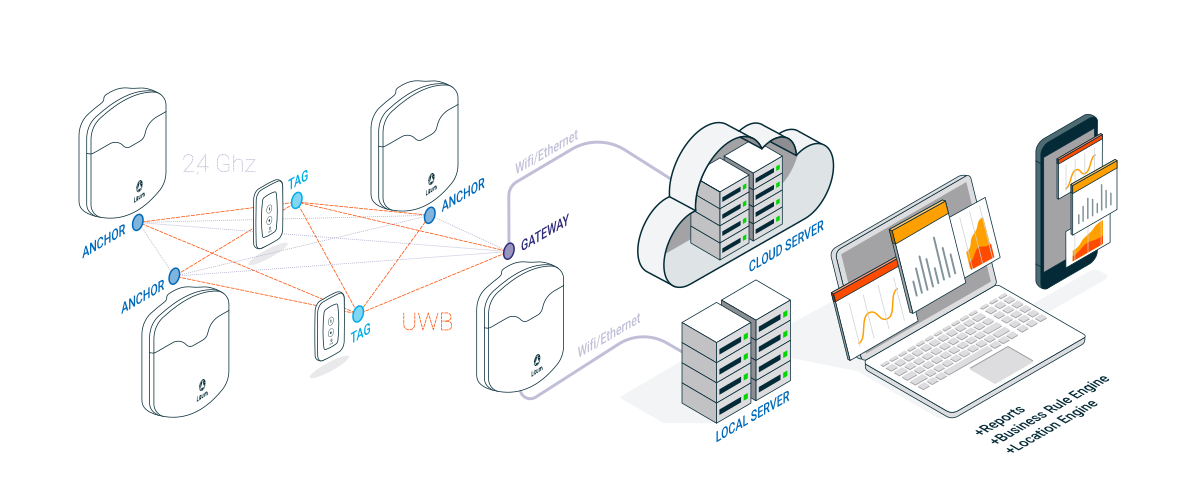
Litum uses active RTLS tags that can be used for specific reasons such as integration with asset tracking software. To find out more about how Litum can help improve your operations, contact us now.
How RFID Location Tracking Supports Emergency Mustering
When an evacuation alarm triggers, knowing where every person was last located is not a nice-to-have, it is a regulatory requirement. Litum’s active RFID location tracking system integrates directly with emergency mustering, automatically generating a live headcount at designated assembly points without any manual roll call.
As personnel move toward muster points, the system updates their status in real time. Any individual whose tag has not been detected at a muster zone is flagged immediately, with their last known location displayed on the facility map for emergency responders. This reduces the time to full accountability from 15-30 minutes with paper-based methods to under a minute.
For facilities operating under OSHA emergency action plan requirements (29 CFR 1910.38) or sector-specific frameworks in oil and gas, construction, and healthcare, RFID-based mustering also generates time-stamped compliance reports automatically for every drill and real emergency event.
RFID Location Tracking Across Industries
Active RFID location tracking is deployed across a wide range of industrial and commercial environments. The use cases differ by sector, but the underlying requirement is the same: real-time visibility into where personnel and assets are at any given moment.
- Manufacturing: Zone-level personnel monitoring in production areas, automated proximity alerts near machinery, and integration with asset tracking for coordinated equipment and workforce visibility
- Oil, gas, and energy: Personnel accountability in hazardous zones, automated mustering during unplanned shutdowns, and lone worker safety monitoring in remote or isolated work areas
- Healthcare: Staff location tracking across patient care zones, duress alert response, and visitor accountability during emergency situations
- Construction and jobsites: Multi-zone personnel monitoring, PPE compliance enforcement by zone, and evacuation accountability across large outdoor and indoor work areas
- Warehousing and logistics: Coordinated tracking of personnel and equipment, safety enforcement in forklift operating zones, and movement history for incident investigation
Each deployment uses the same Litum RTLS infrastructure, so organizations do not need separate systems for different use cases.
Active RFID vs. Passive RFID: Which Is Right for Your Facility?
The choice between passive and active RFID depends on the level of location visibility your operation requires.
Passive RFID is appropriate when checkpoint-level detection is sufficient: knowing when a person or asset enters or leaves a defined zone, passes through a gateway, or checks into a workstation. It works well for access control and attendance logging because it only needs to register a presence event, not a continuous position.
Active RFID is the right choice when real-time, continuous location data is required across a large or complex facility. The table below shows the practical differences:
| Passive RFID | Active RFID (Litum RTLS) | |
|---|---|---|
| Read range | Up to 7 meters | Up to 50 meters |
| Location update | Checkpoint only | Continuous, real-time |
| Tag power source | Reader signal | Internal battery |
| Panic button support | No | Yes |
| Sensor data (temp, motion) | No | Yes |
| Emergency mustering | Manual workaround required | Automated, real-time |
| Best for | Access control, attendance | Full facility location visibility |
For most industrial environments where safety, emergency response, and operational awareness are priorities, active RFID delivers capabilities that passive systems cannot replicate.
Frequently Asked Questions
What is the difference between RFID tracking and RTLS?
RFID (Radio Frequency Identification) is the underlying technology: a tag and reader system that uses radio waves to identify and locate objects. RTLS (Real-Time Location System) is the complete platform built on top of that technology, combining readers, tags, location software, and a live facility map to display position data continuously. All Litum RTLS systems use active RFID as their core technology.
How accurate is RFID location tracking indoors?
Active RFID systems deliver zone-level to room-level accuracy, typically placing a tag within a defined area of 3 to 10 meters. For environments requiring sub-meter precision, UWB (Ultra-Wideband) technology can be layered in. For most industrial, healthcare, and warehouse applications, zone-level RFID accuracy is sufficient for safety monitoring, emergency mustering, and operational visibility.
Can RFID location tracking work during a power outage?
Litum’s RTLS operates on cloud infrastructure backed by GSM connectivity, which means the system continues functioning during local power or network failures. This is particularly important for emergency mustering, where location data is most critical precisely when normal facility systems may be disrupted.
Does RFID location tracking work outdoors?
Active RFID and BLE tags function outdoors with appropriate reader infrastructure. For large outdoor sites such as construction yards, petrochemical plants, or port facilities, Litum systems can combine indoor RFID coverage with GPS for seamless indoor-outdoor location continuity.