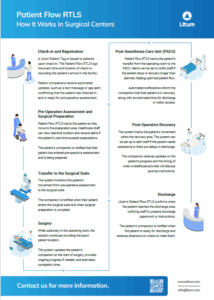
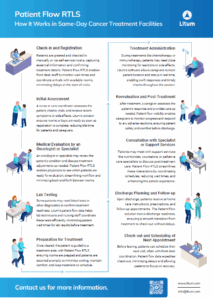
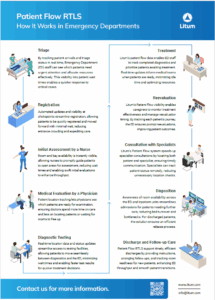
Litum’s Patient Flow RTLS helps hospitals and specialty care facilities move patients smoothly through every stage of care, reducing wait times and improving experiences. Real-time tracking and automated updates keep care teams informed, cutting delays and freeing more time for patient care.
Delays, overcrowding, and long waits not only frustrate patients but can also affect HCAHPS scores, strain staff, and disrupt care delivery.
Litum’s Patient Flow RTLS tracks every step from admission to discharge, using real-time data to smooth transitions, reduce bottlenecks, and improve throughput, helping meet operational benchmarks and compliance goals.
With Patient Flow RTLS, you can:
Reduce bottlenecks and ensure smoother patient transitions
Optimize care pathways and resource planning using historical data
Automate patient registration, admission, and discharge processes
Minimize patient wait times, improving quality of care
Enhance patient safety by tracking zone-based patient movement
Improve Efficiency with Real-Time Data
Litum’s Patient Flow RTLS delivers actionable insights to optimize bed turnover and keep patient flow moving, critical for meeting throughput goals and avoiding ED boarding. By tracking bed availability and patient status in real time, care teams can expedite discharges, reduce admission delays, and ensure efficient use of staffed beds. Immediate alerts on status changes help allocate resources where they’re needed most, supporting informed decision-making, CMS quality reporting, and continuous performance improvement.
Enhance Patient Safety and Satisfaction
By integrating real-time location tracking and automated alerts, Litum’s Patient Flow RTLS supports Joint Commission patient safety goals and enhances the care experience. It helps prevent errors, ensures timely assistance, and increases transparency for patients and families. Automated alerts for patient movement or status changes allow staff to respond quickly, improving safety through continuous monitoring and rapid response. By minimizing wait times and improving communication, the system boosts patient satisfaction scores, fosters trust, and helps create a safer, more responsive care environment.
Patient flow RTLS is a real-time location system that tracks patients as they move through a hospital or care facility. It gives care teams live visibility into where each patient is, how long they have been waiting, and where delays are forming, so staff can act before small bottlenecks become bigger problems.
How does RTLS improve patient flow in hospitals?
RTLS replaces manual check-ins and verbal status updates with automatic, real-time location data. Care teams see patient locations and wait times on a live dashboard. This reduces time spent locating patients, speeds up handoffs between departments, and helps supervisors identify which areas are congested before delays escalate.
What causes poor patient flow in hospitals?
Common causes include long wait times in ED or pre-op, delayed room turnovers, bottlenecks at discharge, inefficient handoffs between departments, and care teams spending time searching for patients or equipment. RTLS addresses most of these by providing continuous visibility across all stages of care.
Can RTLS reduce patient wait times?
Yes. By giving care teams real-time visibility into patient location and status, RTLS helps staff respond faster at each transition point, from triage to discharge. Facilities using patient flow RTLS typically see measurable reductions in wait times and length of stay.
What departments benefit most from patient flow tracking?
Emergency departments, surgical suites, pre-op and post-op areas, and discharge units see the most immediate impact. Any department with high patient throughput and frequent handoffs between care teams benefits from real-time location visibility.
Does patient flow RTLS integrate with hospital systems?
Yes. Litum’s platform integrates with nurse call systems, EMR/EHR platforms, and other hospital systems so patient location data flows into existing workflows without requiring staff to use separate tools.
Can the same RTLS platform support other hospital use cases?
Yes. The same infrastructure supports infant security, staff duress, wander management, medical asset tracking, and staff workflow monitoring, all without requiring separate systems for each use case.